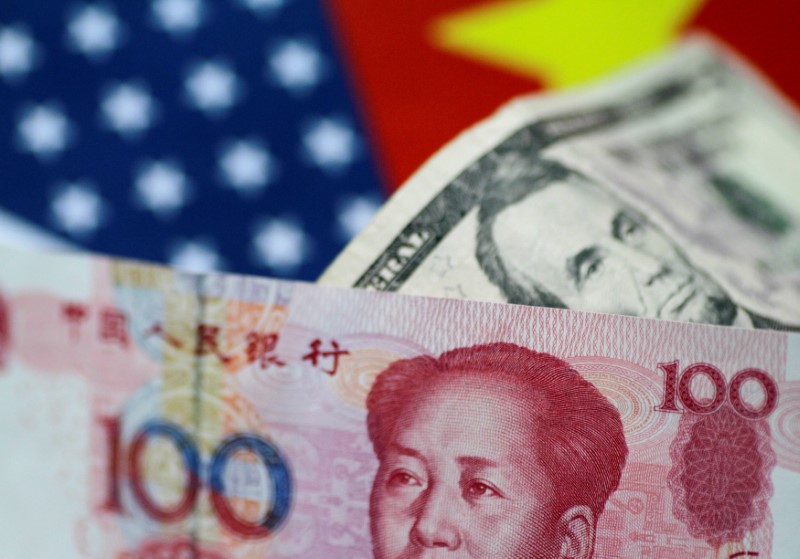
Asian currencies saw modest gains as the dollar weakened ahead of U.S.-China trade talks in London, where officials will discuss tariffs and export rules; however, markets remain cautious pending concrete outcomes. China's yuan remained flat following soft inflation data and disappointing export figures, with CPI easing for the fourth consecutive month and producer inflation falling sharply, while Japan's economy contracted less than initially estimated in Q1 amid weak consumer spending and exports.
Asian foreign exchange markets exhibited modest strength on Monday, largely attributed to a retreat in the U.S. dollar ahead of significant U.S.-China trade negotiations scheduled in London. The US Dollar Index, measuring the greenback against major currencies, fell 0.2% in Asian trading hours after a Friday surge on strong U.S. jobs data, though US Dollar Index Futures were reported as trading 0.2% higher. High-level U.S. officials, including Treasury Secretary Scott Bessent and Commerce Secretary Howard Lutnick, are set to meet China’s Vice Premier He Lifeng to discuss tariff rollbacks, export rules on technology and critical minerals, and broader trade frameworks, building on a previous tentative truce. Despite initial market optimism for easing global trade tensions, a cautious sentiment prevails as traders await concrete outcomes rather than rhetoric, particularly with U.S. consumer price index (CPI) inflation data looming later in the week. Specific currency movements saw the Singapore dollar (USD/SGD), Indian rupee (USD/INR), and South Korean won (USD/KRW) pairs decline by 0.2% (indicating strengthening of these Asian currencies against the USD), while the Australian dollar (AUD/USD) pair rose 0.3%. The Japanese yen also strengthened, with the USD/JPY pair falling 0.3%. In contrast, the Chinese yuan (both onshore USD/CNY and offshore USD/CNH) remained largely unchanged, influenced by domestic data showing Chinese consumer price index inflation easing for a fourth consecutive month in May and producer inflation falling at its sharpest pace in nearly two years. Furthermore, China's export growth missed expectations due to U.S. trade tariffs, though its trade balance grew due to a decline in imports. Separately, Japan's first-quarter GDP contracted slightly less than initially estimated, but the economy still faces challenges from stagnant consumer spending and falling exports linked to trade uncertainties.
AI-powered research, real-time alerts, and portfolio analytics for institutional investors.
Request DemoOverall Sentiment
mixed
Sentiment Score
0.10
