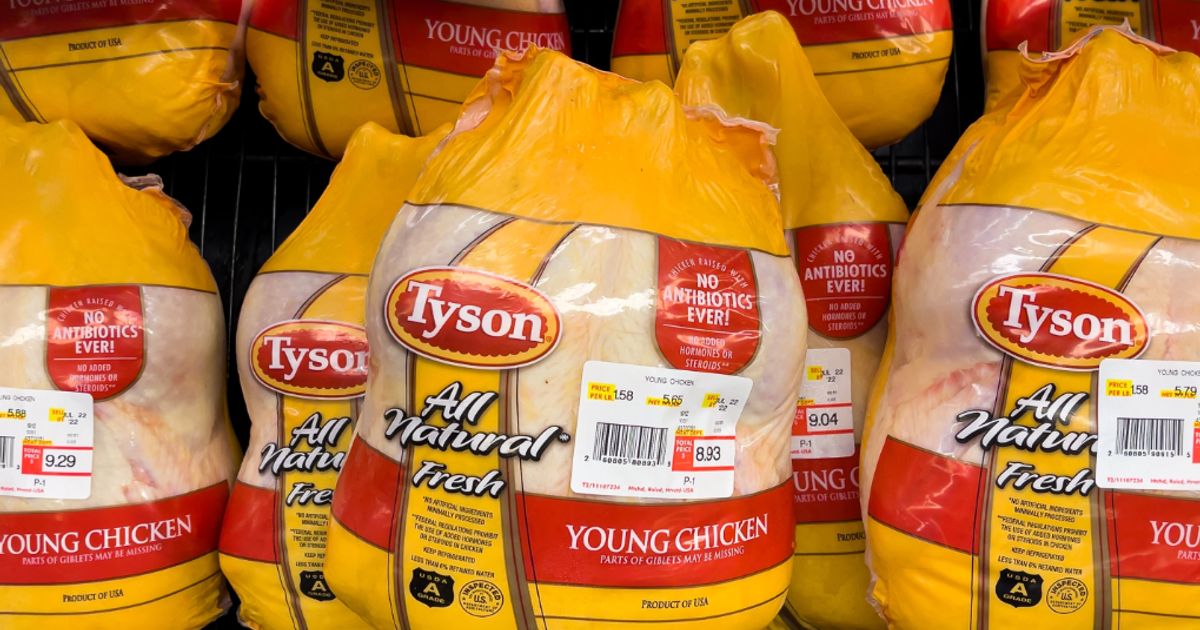
Tyson Foods beat Q1 estimates with adjusted EPS of $0.97 versus $0.94 and revenue of $14.31 billion (up 5.1% and above a $14.09 billion forecast), reporting net income of $85 million. Strength in Chicken (fifth consecutive quarter of volume gains and a 10.9% operating margin) and Prepared Foods offset weakness in Beef, which posted a negative 2.4% margin driven by limited cattle supply and a $150 million legal contingency accrual. Management guided FY capex of $700 million–$1 billion, sales growth of 2%–4% and adjusted operating income of $2.1 billion–$2.3 billion, with Chicken expected to generate $1.65 billion–$1.9 billion in profit while Beef is forecast to lose $250 million–$500 million. Shares ticked up ~0.8% in early trading on the mixed-but-beating results.
Market structure: Tyson’s print and guidance make poultry and prepared-foods clear winners (Pilgrim’s Pride PPC, Hormel HRL) as chicken operating margin (10.9%) and projected chicken profit $1.65–1.9B offset a structurally weak beef segment (forecasted -$250–500M). Beef packers and regional processors with heavy cattle exposure will see compressing margins as limited cattle supplies keep live-cattle prices elevated; cattle producers benefit short-term but processors lose pricing power. Cross-asset: expect higher CME live cattle (LC) implied vols, upward pressure on corn/soy (ZC/ZS) via feed demand, and modest widening of TSN credit spreads if beef losses persist beyond two quarters.
Risk assessment: Tail risks include legal exposure rising well above the $150M accrual, an avian-flu shock reversing chicken volumes, or a fast herd rebuild in 12–24 months that normalizes cattle supply and restores packer margins. Near-term (days–weeks) the stock will trade on flow and monthly USDA Cattle on Feed data; medium-term (3–6 months) on Q2 margins and capex deployment; long-term (12–24 months) on structural protein mix and any divestiture decisions. Hidden dependencies: grocery vs foodservice channel recovery and feed-cost pass-through ability to retail prices.
Trade implications: Implement a relative-value poultry bet: establish a 1–2% portfolio long in PPC and an equal-dollar 1–2% short in TSN to capture chicken outperformance over 3–6 months, stop-loss 6% on either leg. If you prefer TSN outright, sell 30–60 day covered calls 3–5% OTM to collect premium while holding a 1–3% core position; alternatively buy a 3–6 month TSN put spread to hedge downside if beef losses widen beyond guidance. Use CME live cattle put spreads (LC) to hedge processor exposure if data shows rising feeder cattle prices over next 60 days.
Contrarian angles: The market underestimates management’s ability to reallocate capex ($700M–$1B) toward chicken and value-create via M&A/spin of beef assets—if Tyson hits upper chicken profit guide ($1.9B), TSN could rerate materially; conversely, the $150M accrual may be a floor and litigation could expand, creating a >10% downside. Historical cycles (post-2015 herd rebuilds) show beef-margin mean reversion over 12–24 months, so avoid large permanent shorts on the sector and prefer tactical relative and options hedges tied to USDA cattle/inventory releases.
AI-powered research, real-time alerts, and portfolio analytics for institutional investors.
Request DemoOverall Sentiment
mildly positive
Sentiment Score
0.25
Ticker Sentiment
