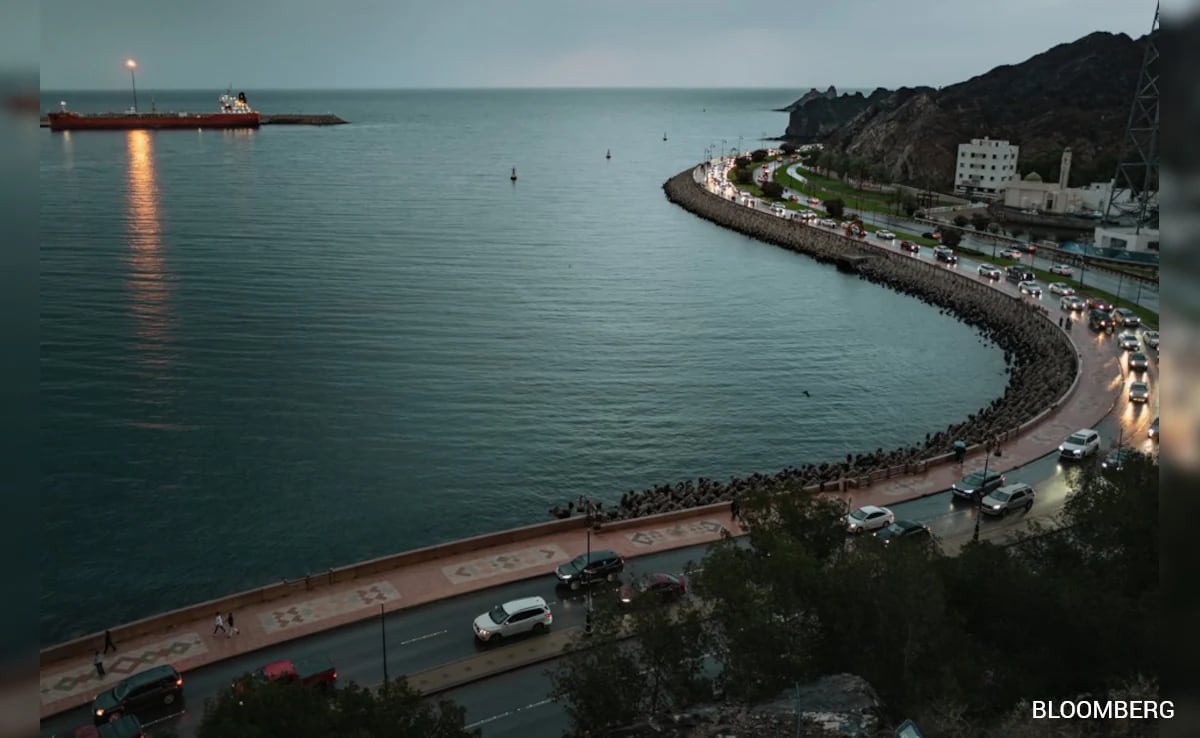
Three Omani-managed vessels — two supertankers each carrying about 2 million barrels of crude and one LNG carrier (apparently empty) — hugged Oman's coast to enter the Strait of Hormuz, potentially avoiding Iran-controlled northern routes. Iran is drafting a protocol with Oman to monitor traffic and is seeking tolls of up to $2 million per voyage, while the strait’s effective closure has already pushed energy prices higher. Tracking is hampered by signal jamming/spoofing; one tanker loaded in Saudi Arabia was bound for Kyuakpyu (serving western China), highlighting potential supply-route diversion risks and near-term volatility in oil/gas markets.
The emergence of a southern coastal corridor that can accept the largest crude and LNG carriers materially changes how market participants price chokepoint risk. If even a modest number of VLCCs and LNG tonnage resume regular eastward voyages, the marginal physical supply to Asia could rise enough to shave several dollars per barrel off Brent over a 2–8 week window, as charterers avoid longer ship-to-ship lifts and smaller parceling. This effect is amplified for heavy/sour grades that are economically shipped on VLCCs — refiners with coking/upgrade capacity would see the most immediate benefit to throughput economics.
Second-order winners are not limited to producers: VLCC owners and modern LNG-ship operators capture re-rate optionality (spot rates and TCEs can reprice sharply if demand for deep-draft routing rises), while regional ports and bunker suppliers on the Omani coast extract fees and ancillary revenue. Offsetters include owners of smaller Aframax/Suezmax tonnage and short-haul lightering services, which lose margin if large-unit efficiency returns. Insurance and war-risk premia remain a nonlinear cost: a credible, routinized protocol will compress premia; episodic enforcement or captures will explode them.
The primary near-term market uncertainty is signal integrity—AIS jamming/spoofing leaves a high false-positive rate for confirmed transits. Catalysts to watch are: formal bilateral passage protocols (weeks–months), a noticeable uptick in VLCC spot fixtures to Asia (days–weeks), and any insurance market announcements restricting coverage (immediate). A reversal can be swift if Iranian enforcement, Western interdiction, or underwriter pullback reintroduces high marginal costs to the route.
From a portfolio perspective this is a mixed event: it reduces a pure ‘supply blackout’ premium (bearish for crude) while creating a volatility/arbitrage opportunity in shipping assets and freight markets. Trades should therefore be structured to capture a short-term oil-price compression while owning idiosyncratic optionality in vessel owners and LNG-transport equities, with explicit hedges against geopolitical upside spikes.
AI-powered research, real-time alerts, and portfolio analytics for institutional investors.
Request DemoOverall Sentiment
mildly negative
Sentiment Score
-0.25
