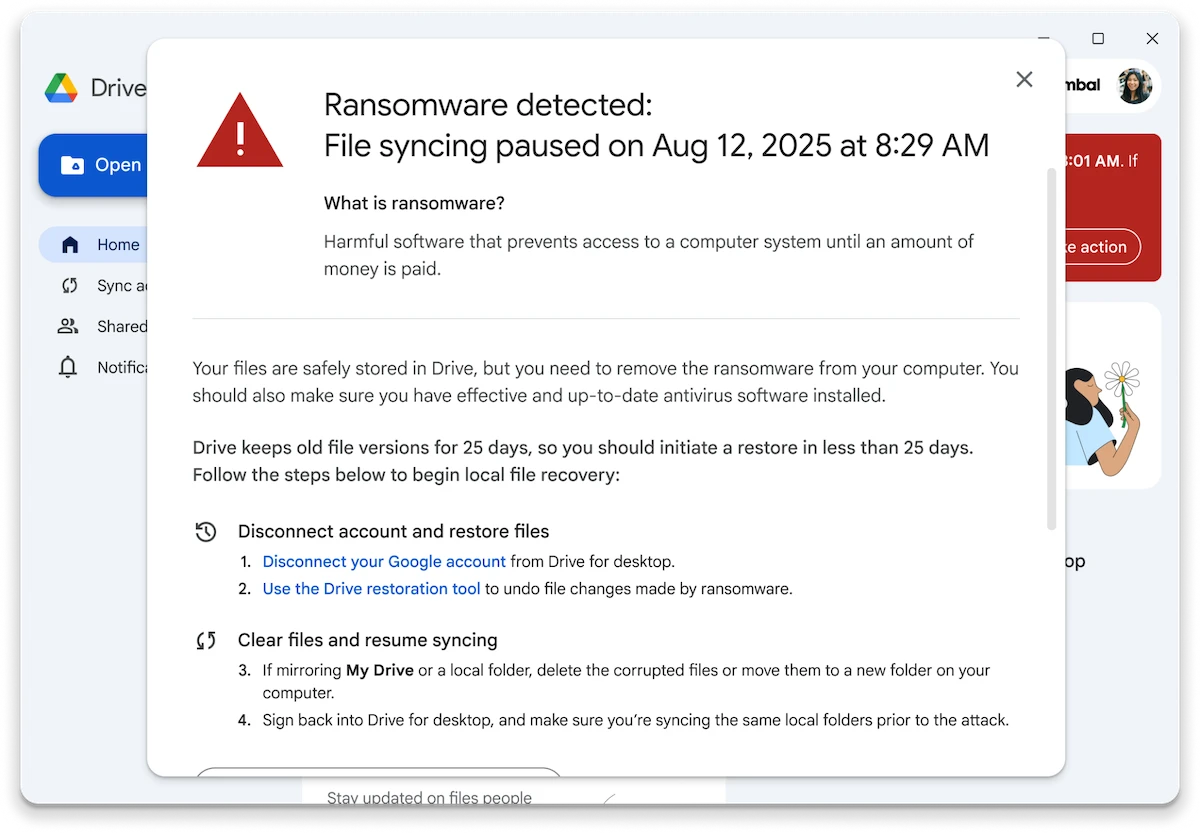
Google made ransomware detection and file restoration in Drive generally available; its latest AI model detects 14x more infections and can restore files modified within the past 25 days. With these features enabled by default, Drive for desktop scans files during sync, pauses syncing and notifies users and admins on detection, and permits bulk restoration to previous unencrypted versions, while admins can toggle the features at the OU level.
Embedding automated ransomware detection and rollback inside a widely deployed productivity client changes the marginal economics of endpoint protection: it converts a product differentiator into a sticky enterprise feature rather than a standalone license. Expect this to raise Workspace’s competitive “moat” over the next 6–18 months by lowering the incremental ROI for customers that might otherwise bolt to best-of-breed backup/IR vendors, translating to low-single-digit percentage improvements in retention/wallet-share for Workspace in enterprise cohorts if adoption scales.
The second-order pressure will be most acute on specialist recovery and managed-IR providers whose incident volumes and billable-hours per event are sensitive to ease-of-restore; conversely, EDR vendors that integrate and feed telemetry into cloud platforms could see engagement lift as they shift to partnership models. Adversaries are likely to pivot: expect rapid model-evasion attempts and “time-to-exfiltrate” strategies, meaning detection efficacy could meaningfully degrade in 3–9 months unless continuous model retraining and telemetry diversity scale faster than attacker adaptations.
Operationally, the default-on posture creates a regulatory and forensic friction point for highly regulated verticals; legal/forensic preservation requirements could drive security teams to opt out in finance/healthcare, delaying benefits into a longer rollout curve. Net-net: positive strategic moat enhancement for the platform over 6–18 months, but asymmetric short-term implementation and adversary-response risks that create a binary adoption/catalyst path.
AI-powered research, real-time alerts, and portfolio analytics for institutional investors.
Overall Sentiment
mildly positive
Sentiment Score
0.30
Ticker Sentiment
