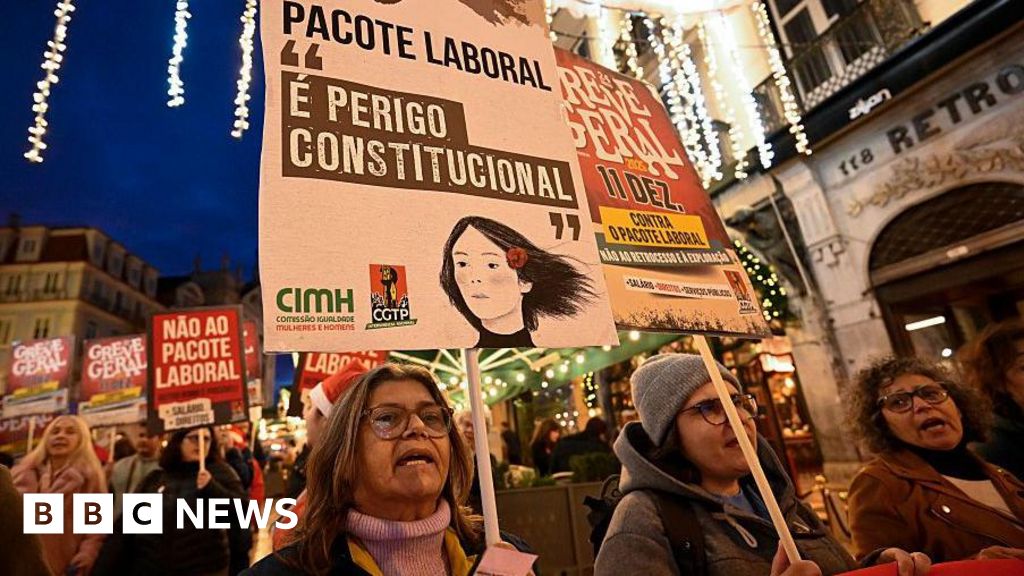
Portugal’s two main unions staged a nationwide general strike — the first joint action in 12 years — causing cancellations of flights and trains, school closures, postponed hospital operations and halted refuse collections as CGTP and UGT protest a government labour-reform package of more than 100 measures. The bill, championed by Prime Minister Luís Montenegro to tackle “rigidities” and boost competitiveness despite Portugal’s recent status as the eurozone’s fastest-growing economy, would ease limits on temporary contracts, allow dismiss-and-rehire via outsourcing and remove a reinstatement requirement for unfair dismissal, drawing fierce union condemnation and public opposition. Politically the reforms expose the fragility of Montenegro’s minority right‑of‑centre coalition — which needs support from small pro‑market and hard‑right parties and faces internal dissent — and risk constitutional or presidential scrutiny ahead of January’s election; the broad private‑sector participation (e.g., nearly 1,000 Autoeuropa workers backing the strike) raises policy and operational risk for corporates and investors sensitive to labour costs and social stability.
Portugal's two main unions, CGTP and UGT, staged a nationwide general strike — the first joint action since 2013 — causing cancelled flights and trains, school closures, postponed hospital operations and halted refuse collections, with public transport reduced to minimum service. Private-sector participation was notable: nearly 1,000 Autoeuropa workers voted to back the action, and a Social Democrat MP on the UGT executive even supported the strike, highlighting cross-cutting political and social opposition.
The strike targets a government labour-reform package of more than 100 measures promoted by Prime Minister Luís Montenegro to address perceived "rigidities" despite Portugal being the eurozone's fastest-growing economy in recent months. Key contentious provisions include indefinite rolling over of temporary contracts, permitting dismiss-and-rehire via outsourcing, and removing the reinstatement requirement for unfair dismissal; the bill was not in the coalition manifesto and Montenegro's minority government must court the Liberal Initiative and hard-right Chega for passage.
Political and policy risk are elevated: unions describe the package as an assault on workers' rights, formal talks were labelled unbalanced by UGT, and the president or Constitutional Court could delay or block legislation ahead of January's presidential election, creating binary outcomes. For investors this combination of operational disruption (transport, tourism, auto) and legislative uncertainty produces near-term downside to activity and earnings, while a successful passage would materially change labour-cost dynamics and competitiveness over the medium term.
AI-powered research, real-time alerts, and portfolio analytics for institutional investors.
Request DemoOverall Sentiment
moderately negative
Sentiment Score
-0.50
