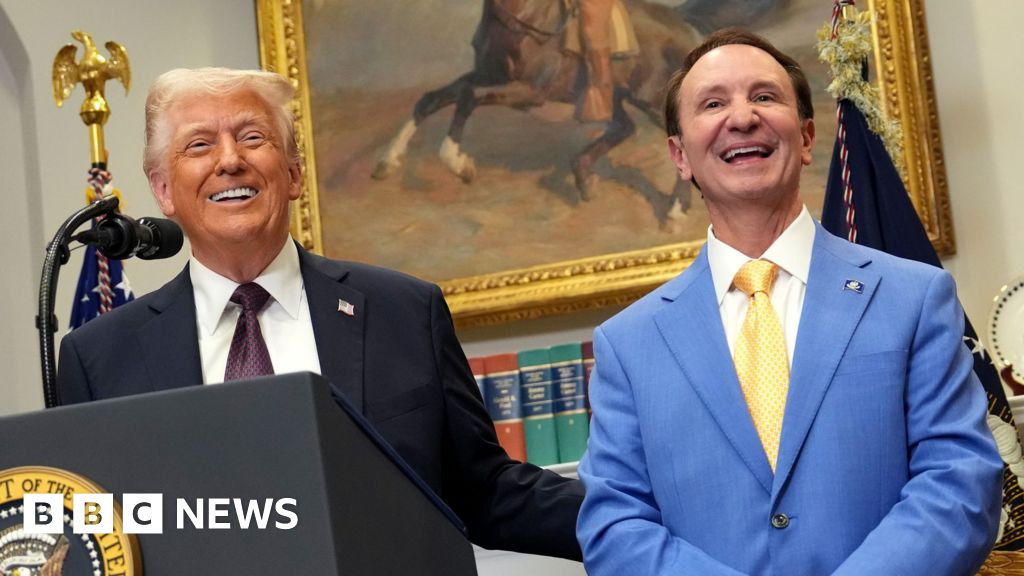
President Trump has appointed Louisiana Governor Jeff Landry as a volunteer special envoy to Greenland with the stated aim of bringing the island into the United States, prompting strong objections from Denmark and calls to respect Greenlandic territorial integrity. Greenland (population ~57,000) is strategically important for NATO and US defense — hosting a US base since WWII and reopened a consulate in Nuuk in 2020 — and is rich in mineral resources, so the move heightens geopolitical risk in the Arctic, risks diplomatic friction with allies and could influence defense and natural-resources exposure among investors. Managers should monitor potential policy escalation, NATO diplomatic reactions, and any accelerated US activity in Arctic security or resource access that could affect defense contractors, miners and shipping routes.
Market structure: Direct winners are US defense primes (Lockheed LMT, Northrop NOC, Raytheon RTX) and strategic-mineral miners (MP Materials MP, Lynas LYC, Rio Tinto RIO for base metals exposure) because sustained US Arctic focus increases defence procurement and long-run demand for critical minerals; losers are Danish sovereign political-risk-sensitive assets and commercial Arctic tourism/transport providers. Supply/demand: meaningful upward pressure on REE, copper and nickel fundamentals is multi-year (3–7 years) not immediate — expect 10–30% re-rating windows tied to permitting and offtake announcements. Cross-asset: near-term risk-off could push gold (GLD +) and long-duration Treasuries (TLT +), and support USD (UUP +); shipping insurance and Arctic transit premiums could lift dry-bulk and insurance spreads.
Risk assessment: Tail risks include a low-probability military or sanctions spiral that would trigger a broad equity drawdown (-10–25%) and commodity dislocations; diplomatic escalation within 60 days is the highest near-term trigger. Hidden dependencies: Greenlander political opposition and Danish/NATO legal control make rapid resource monetization unlikely, lengthening timelines and amplifying execution risk for juniors. Catalysts: US defense budget decisions (FY+1 appropriations in next 6–12 months), Greenland mining permits or major offtake deals (12–36 months), and Chinese/Russian Arctic moves.
Trade implications: Favor 6–18 month overweight to defence primes (LMT, RTX, NOC) — use 6–12 month call spreads to limit capital and buy 12–36 month outright positions in REE miners (MP, LYC) for strategic-material optionality; hedge with GLD and TLT if VIX >25 or if diplomatic rhetoric escalates. Pair trades: long LMT (2–3% NAV) / short BA (1–2% NAV) to capture defense vs commercial aerospace divergence; rotate out of small European cyclical exporters if Nordic sovereign risk premium widens >30bps. Entry: scale 25% now, 50% over 3 months, stop-losses 10–12%.
Contrarian angles: Consensus over-weights fast-resource-extraction outcomes; reality is slow — meaningful mining revenue is 3–7 years out, so juniors are likely overbought on headlines while primes get durable upside from nearer-term defence budgets. Historical parallels (Cold War Arctic infrastructure buildout) suggest steady, lumpy government capex rather than rapid privatization — favor cash-generative defence names and select mid-cap miners with permits over speculative explorers. Unintended consequence: strong US push could catalyze EU/NATO integrated Arctic strategies boosting European defence contractors; consider rebalancing if EU announces coordinated procurement.
AI-powered research, real-time alerts, and portfolio analytics for institutional investors.
Request DemoOverall Sentiment
moderately negative
Sentiment Score
-0.30
