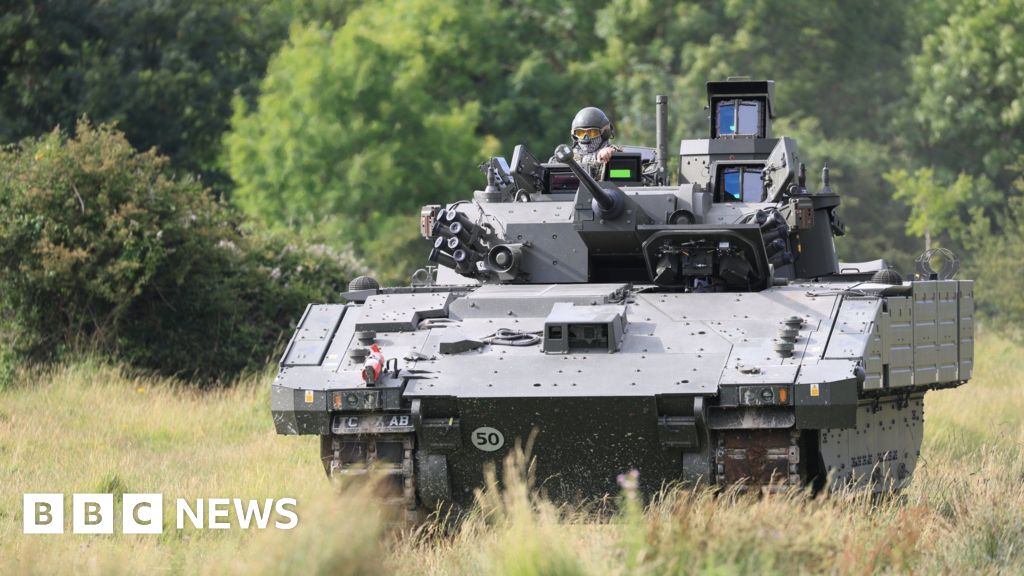
The UK has paused all trials of the £6.3bn Ajax armoured-vehicle programme after a soldier fell ill during additional safety testing; 23 vehicles had already been suspended after around 30 soldiers reported injury from noise and vibration during a November exercise. Three investigations (Defence Accident Investigation Branch, the Army's safety team and a ministerial review) are underway, the programme (589 vehicles planned, built by General Dynamics in Merthyr Tydfil) faces further delays and has pushed the government's defence investment plan into 2026, creating operational, reputational and employment risks for the contractor and potential implications for UK defence spending.
Market structure: General Dynamics (GD) is the direct loser as the Ajax pause threatens near-term revenue, backlog and margins tied to a £6.3bn UK programme; UK primes with local footprint (e.g., BAE Systems, ticker BAES.L) and European land-systems vendors (e.g., Rheinmetall, RHM.DE) are the short-term potential beneficiaries for replacement work or follow‑on contracts. Expect GD's UK production volumes to fall by a material mid-single-digit percentage of segment revenue over the next 3–12 months if the pause persists, pressuring free cash flow and raising CDS/implied-vol volatility. Cross-asset: GD equity and credit spreads should widen; implied vol in GD options will spike; GBP moves likely muted (<1–2%) but political risk could add modest pressure to sterling on worsening headlines.
Risk assessment: Tail risks include full programme cancellation or government claims forcing GD to incur write‑downs/penalties on the order of hundreds of millions (10–30% of program value)—low probability but high impact. Immediate (days) risk: headline-driven equity volatility and meetings with MPs; short-term (weeks–months): investigation findings and ministerial review (expected Q1–Q2 2026) that can change legal exposure; long-term (≥12 months): UK defence investment plan delay to 2026 reallocates or compresses future awards. Hidden dependency: UK political imperative to preserve 400 local jobs may blunt worst-case commercial penalties, limiting downside or producing delayed cash outflows instead of immediate write-offs. Key catalysts: investigative reports, official findings, Defence Investment Plan publication, GD quarterly comments.
Trade implications: Direct play: establish a tactical short of GD equity (2–3% portfolio) or buy 3–6 month puts sized to cover position, targeting a 20–40% downside if negative findings are confirmed; set stop-loss at +8–10% from entry. Pair trade: long BAES.L (or RHM.DE) and short GD notional‑neutral (1:1 revenue‑adjusted) to capture reallocation of UK land system spend; horizon 3–12 months. Options: buy GD 6‑month 15% OTM puts and sell 30‑60 day calls to finance premium if your view is negative; alternatively buy 12‑month 25% OTM calls as a contrarian upside hedge if price falls >15%.
Contrarian angles: Consensus may overstate cancellation risk—UK government incentives to preserve local jobs and industrial capability make remediation and continued procurement the more likely outcome, capping GD downside and creating a mean‑reversion opportunity after overreaction. Historical UK procurement shocks (program pauses with subsequent remediation) often result in negotiated fixes rather than outright cancellations; if investigations clear GD or compel a paid remediation, anticipate a 20–40% rebound in equity within 3–9 months. Unintended consequence: heavy short positioning could be squeezed if the government backstops costs; therefore size shorts conservatively and hedge with long-dated calls or pair positions.
AI-powered research, real-time alerts, and portfolio analytics for institutional investors.
Request DemoOverall Sentiment
moderately negative
Sentiment Score
-0.50
Ticker Sentiment
