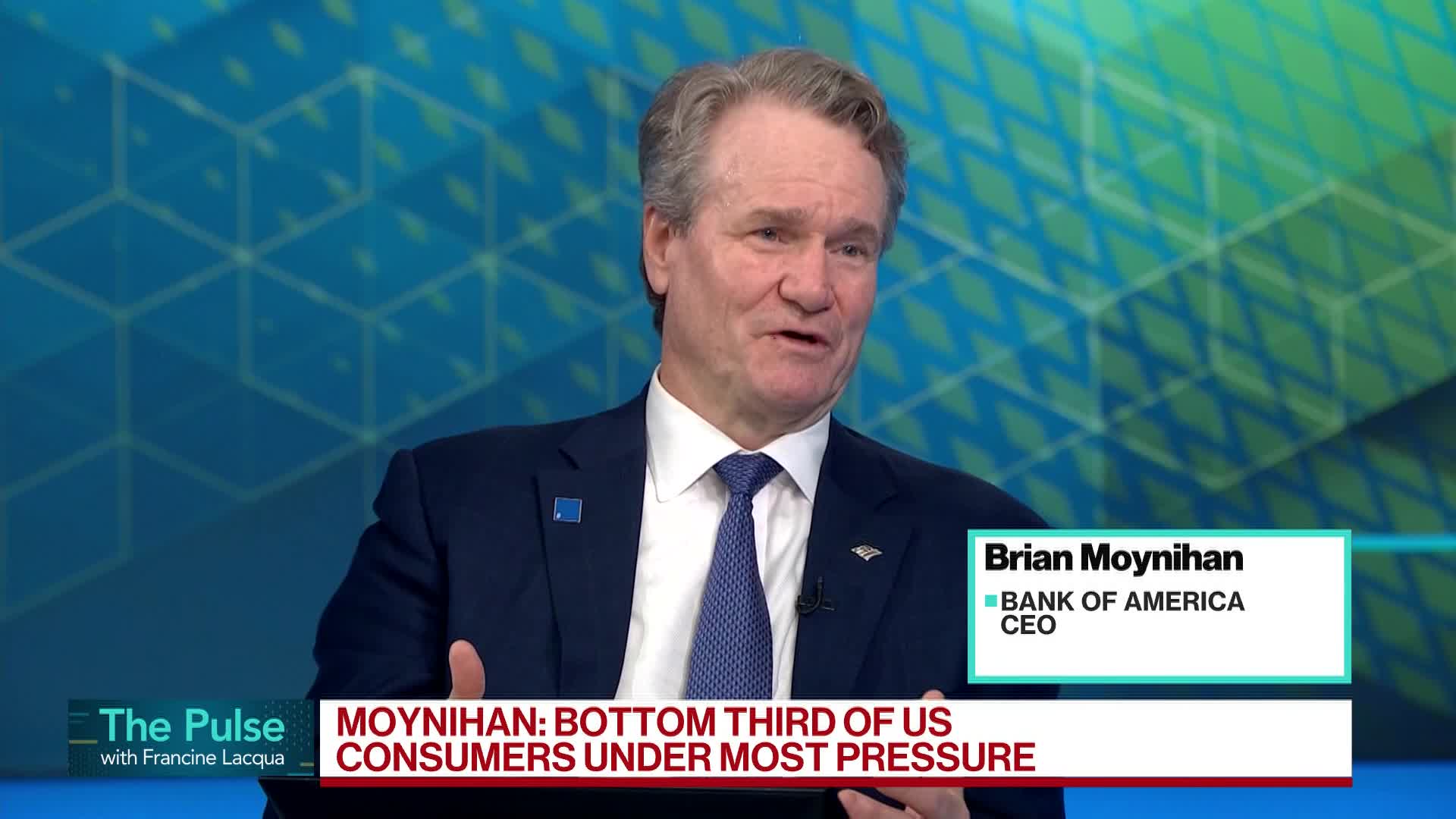
Consumer spending held up through Black Friday/Cyber Monday with November year‑over‑year spending cited around 4.2–4.5%, and the team forecasts U.S. GDP growth of ~2.4% next year with unemployment near 4.4%. The speaker expects the Fed to begin cutting soon and projects a longer‑run fed funds rate near 3% and the 10‑year around 4.5%; inflation remains “sticky” and affordability is a persistent consumer concern. Corporate signals were constructive: net interest income guided to grow 5–7% (versus industry ~3%), a ROTCE goal of 16% moving toward 18% (last quarter 15%) and EPS growth of 25–30% noted, while M&A/IPO activity is improving and the firm reiterated commitment to London and hiring plans in Belfast.
Market structure: Consumer spending strength (Nov ~+4.2–4.5% YoY) and guidance that net interest income (NII) can grow 5–7% (vs industry ~3%) disproportionately benefits large diversified banks (JPM, BAC) and payments (V) through higher fee flow and wider loan-deposit economics as rates normalize toward Fed funds ~3% and 10y ~4.5%. Losers are rate-sensitive long-duration tech and lower-income discretionary retailers where affordability stress compresses margins; expect a 10–30bp intra-week move in the 2s10s if Fed signaling changes. Cross-asset: a firm near-term Fed-cut narrative should weaken USD modestly (1–2%), lift equities (financials > cyclicals), and compress IG spreads; geopolitical shocks are the main commodity upside risk.
Risk assessment: Tail risks include (1) Fed pausing/cancelling expected cuts -> higher short rates and credit-cost risk for leveraged credits, (2) geopolitical escalation (Ukraine/Middle East/Taiwan) -> supply shocks, and (3) regulatory tightening in UK/EU impacting international banks. Immediate catalyst: Fed decision in 7 days; short-term (weeks) catalysts: CPI, NFP, retail sales; long-term (quarters) hinge on unemployment moving >0.5pp from 4.4% or CPI re-accelerating above 3.5% YoY, which would reverse the benign view. Hidden dependency: deposit flight/concentration risk and non-tariff barriers that quietly reduce multinational revenue growth by 5–15% in affected product lines.
Trade implications: Tactical overweight large-cap US banks and payments: prefer JPM for execution and capital return optionality, BAC as a rate-levered beta play but smaller sizing due to credit sensitivity, and V to capture swipe-rate persistence. Implement relative/value trades: long JPM vs short regional bank ETF (KRE) to capture scale advantage; buy 6–9 month JPM call spread (≈10% OTM) to lever upside and sell a further OTM call to finance cost. Rotate out of XRT/consumer discretionary exposure and into financials and investment-grade corporate bonds on a 1–3 month horizon, trimming after the Fed move.
Contrarian angles: Consensus underestimates distributional consumer stress — bottom third’s slower growth implies winners will be premium payment networks and credit card issuers, not mass retailers; positioning should overweight quality transaction franchises. Market may be underpricing the risk that Fed cuts are delayed: if CPI prints >0.3% m/m or unemployment falls <4.2% next month, reassess and de-risk cyclical longs. Historical parallel: 1994–95 rate normalization improved bank ROEs after short volatility; if geopolitics calm, financials could rerate sharply, but a renewed inflation shock would be the largest downside risk.
AI-powered research, real-time alerts, and portfolio analytics for institutional investors.
Request DemoOverall Sentiment
mildly positive
Sentiment Score
0.32
Ticker Sentiment
