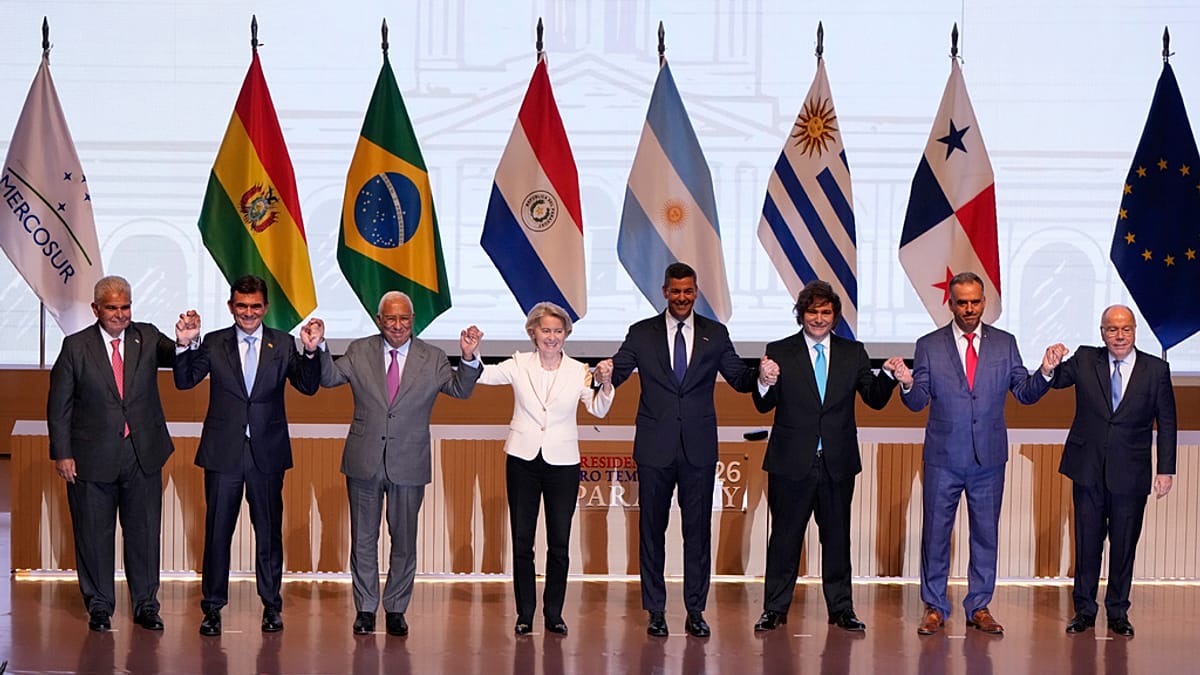
The EU and Mercosur signed a 25-year-negotiated trade deal creating a roughly 700 million-person free-trade area that will gradually eliminate about 90% of tariffs, with the European Commission estimating >€4 billion annual savings in customs duties for EU firms. The agreement grants recognition to 344 geographical indications, aims to secure critical minerals to reduce dependence on China, and opens Mercosur public procurement to EU firms, while capping tariff-free agricultural access (annual beef 99,000 tonnes at a 7.5% reduced tariff; poultry 180,000 tonnes) and allowing safeguard reintroductions if imports rise >5% in sensitive sectors. Commission modelling forecasts EU exports to Mercosur up 39% (€48.7bn) and imports up 16.9% (€8.9bn) by 2040, but ratification is pending in the European Parliament and political/legal challenges could limit near-term market effects.
Market structure: The deal is modestly positive for EU exporters and select Mercosur miners — the Commission’s €4bn duty saving and a projected +39% EU exports to Mercosur by 2040 (≈€48.7bn) shift long‑run revenue mix toward machinery, luxury goods and services. Agricultural impacts are politically salient but quantitatively capped: beef 99,000t (≈1.5% EU production) and poultry 180,000t (≈1.3%) limit commodity shocks, so pricing power erosion for EU farmers is limited at headline levels. Competitive dynamics favor EU branded goods (344 GIs protected) and outsourced critical minerals from Brazil/Argentina, nudging supply chains away from China over years rather than weeks.
Risk assessment: Tail risks centre on political and legal reversal — a European Parliament rejection or ECJ challenge in the next 3–12 months could produce sharp re-pricing (EUR down 2–5%, regional equities down similar magnitude). Short term (days–weeks) expect volatility around parliamentary votes/resolutions; medium (3–12 months) lobbying, safeguard triggers and implementation detail will drive sector dispersion; long term (1–5 years) the structural benefit accrues to miners and exporters if ratified. Hidden dependencies include conditional public procurement access, national compensations (Italy funds from 2028) and fertilizer carbon tax carve-outs that can distort fertilizer and farm-equipment demand patterns.
Trade implications: Tactical opportunities are to overweight Mercosur-facing critical‑minerals miners and EU exporters while hedging political risk; expect modest upward pressure on EUR and sovereign yields if ratification is signalled (EUR +1–3% over 6–12 months; 10y Bunds +10–25bp on credible passage). Commodities: limited immediate beef/poultry pressure; stronger demand for lithium/nickel/iron if sourcing diversifies — favourable for VALE and Argentina LAC developers. Options: prefer 6–12 month call spreads to capture ratification upside and short-dated puts on European equity ETFs to hedge EP vote risk.
Contrarian angle: Market consensus treats signing as near‑done; it underestimates political friction — ratification is binary and likely contested, so full-size buys now are premature. The mispricing opportunity is conditional: if Parliament ratifies within 6 months, expect a compressed rally in miners and EU exporters; if the EP delays or refers to the court, expect a 10–20% re-rating in exposed names. Historical parallels: EU trade deals (e.g., CETA) showed multi‑month lags between signing and durable market reaction, so staged entries with event triggers capture asymmetric returns.
AI-powered research, real-time alerts, and portfolio analytics for institutional investors.
Request DemoOverall Sentiment
mildly positive
Sentiment Score
0.25
