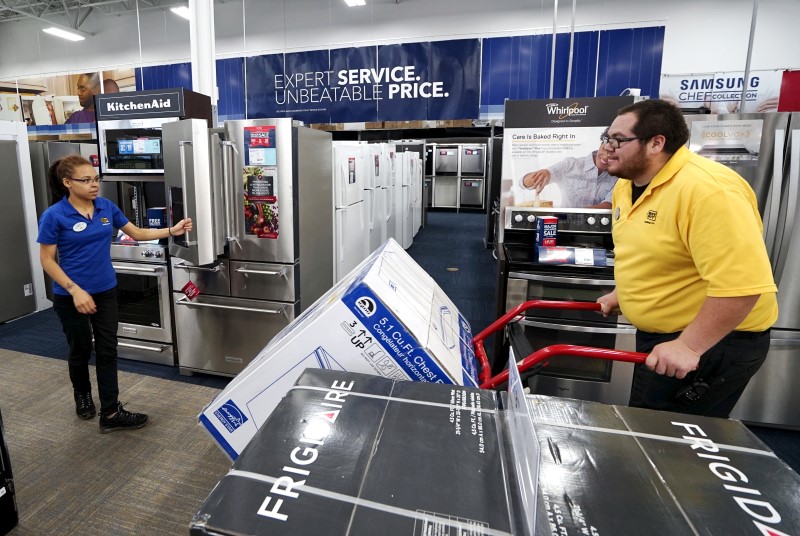
Best Buy reported fiscal Q3 revenue of $9.67 billion (up 2.4% YoY) and adjusted EPS of $1.40 versus $1.30 expected, driven by strength in computing, gaming and online sales (online revenue $2.8 billion, 31.8% of domestic). Adjusted operating income rate improved to 4% (up 30 bps) despite a $192 million pre-tax impairment at Best Buy Health; management raised full-year clarity with guidance of revenue $41.65–41.95 billion and adjusted EPS $6.25–6.35 while issuing a cautious Q4 comparable-sales outlook of -1% to +1%. Strategic initiatives — a newly launched marketplace and expanding retail media/ads — are beginning to contribute to gross-profit rate, while the company continues share repurchases/dividends ($802M returned YTD) and highlights AI-enabled store and fulfillment investments as drivers of longer-term growth.
Market structure: Best Buy’s mix shift toward online (~32% domestic) and retail media/marketplace creates a higher-margin revenue pool that favors omnichannel incumbents (BBY) and ad-tech partners but compresses pricing power for low-service pure-play discounters. Computing/gaming resilience implies upstream beneficiaries (DELL, HPQ, MSFT supply partners) see steadier unit demand even as overall discretionary spending rounds lower; expect gross-profit rate expansion of 25–75 bps over 12–24 months if marketplace adoption scales. Cross-asset: stronger-than-feared retail EPS should modestly tighten IG retail credit spreads (~10–25bps) and depress equity implied vols; near-term bond/FX moves will be driven more by macro than one retailer.
Risk assessment: Main tail risks are a sharper consumer income shock (unemployment +0.5–1ppt or CPI re-acceleration), inventory markdown cascade, or tech/ads privacy regulation that cuts retail-media CPMs by 20–40%. Immediate (days) risk: headline Q4 comp guide could trigger +/-10% swings; short-term (weeks) depends on November retail prints; long-term (2–4 years) hinges on ROI from AI-enabled fulfillment and marketplace scale. Hidden dependency: buybacks (YTD $802M) can hide organic margin weakness — watch gross-profit ex-inventory metrics.
Trade implications: Primary direct play is tactical long BBY (2–3% portfolio) for 12–18 months to capture margin tailwinds and buybacks, hedged for Q4 seasonality with cheap put protection; consider 6–9 month call spreads 10–15% OTM to lever upside with defined risk. Pair trade: long BBY / short FDX (1.5:1) to express resilient retail demand vs. logistics exposure to volume shocks. Options: sell 30–60 day covered calls to harvest elevated post-earnings premium and buy 3–6 month puts if comps guide below -1% to protect downside.
Contrarian angles: Market underestimates how quickly retail-media + marketplace can add 50–150bps to gross-margin over 18–24 months — that’s the operational lever beyond cyclical comps. Conversely, consensus may be complacent about third-party seller cannibalization and ad-revenue cyclicality; a Q4 comp miss could be over-sold by 15–30% relative to fundamentals. Historical parallel: Best Buy’s 2013 omnichannel turnaround shows durable share gains are possible; failure mode is mis-executing marketplace, not consumer demand alone. Unintended consequence: accelerating marketplace could trigger margin volatility as BBY tests pricing vs. third parties.
AI-powered research, real-time alerts, and portfolio analytics for institutional investors.
Request DemoOverall Sentiment
moderately positive
Sentiment Score
0.35
Ticker Sentiment
