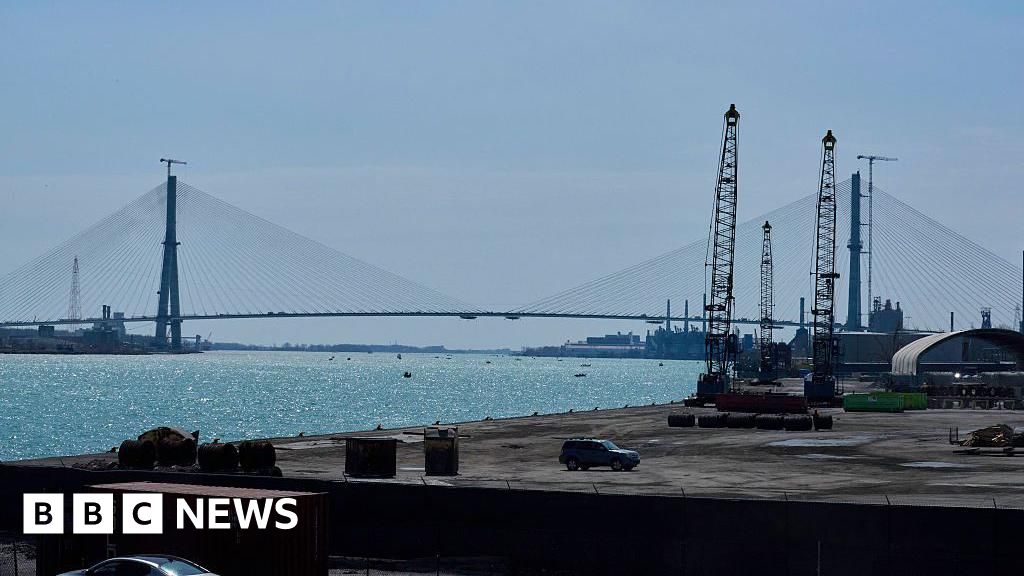
President Trump has threatened to block the opening of the Gordie Howe International Bridge—a Canada-funded, jointly owned US-Canada crossing across the Detroit River that cost an estimated C$6.4bn and is slated to open pending approvals in early 2026—demanding the United States be "fully compensated" and asserting the US should own at least half. The Windsor-Detroit Bridge Authority is wholly Canadian-owned, and Trump linked the dispute to broader trade frictions (including Canadian dairy tariffs and a Canada-China deal), creating political uncertainty for cross-border trade and Michigan-Canada logistics despite unclear legal mechanisms to halt the opening.
Market structure: A US federal block or even credible threat raises short-term pricing power for the incumbent Ambassador Bridge operator (private) and shifts freight to rail and alternate crossings. Expect Canadian railroads (CNI, CP) and regional intermodal yards to capture incremental volume; estimate 5–15% incremental cross-border rail tonnage within 3–12 months if the Gordie Howe opening is delayed >3 months. Auto OEMs with just-in-time Canada–US supply chains (F, GM, STLA) face higher unit logistics cost and potential production hiccups.
Risk assessment: Tail scenarios include a prolonged political/legal blockade (3–18 months) or targeted customs refusal—each could raise regional freight premia and add 50–200 bps to manufacturer COGS for affected models. Immediate market risk (days) is sentiment/FX volatility; short-term (weeks–months) is routing and congestion costs; long-term (quarters–years) is sustained reconfiguration of supply chains. Hidden dependencies: Michigan state/federal preclearance rules, CBP approvals, and private litigation (Moroun family) can accelerate or stymie outcomes.
Trade implications: Tactical winners: CNI/CP (rail freight capture), select freight terminals, and FX (USD/CAD). Tactical losers: exposed auto OEMs (F, GM, STLA), regional trucking integrators dependent on the new bridge. Options can express event risk with limited capital—buy protective puts on OEMs and call exposure to rails.
Contrarian angles: Consensus treats this as political bluster; however, an actual opening delay is plausible given federal leverage and could meaningfully reroute volume for 6–12 months—markets underprice this operational risk. A delayed opening could perversely boost Canadian rail earnings by mid-single-digit EPS percentage points for CNI/CP in FY+1 while depressing US OEM margins; the path to resolution (law suits, state interventions) is the key catalyst.
AI-powered research, real-time alerts, and portfolio analytics for institutional investors.
Request DemoOverall Sentiment
moderately negative
Sentiment Score
-0.35
