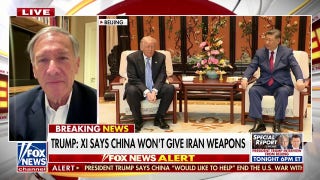
Trump’s China visit centered on U.S.-China geopolitical tensions, including Taiwan, Iran, and high-level bilateral diplomacy with Xi Jinping. Trump said he made no commitment on defending Taiwan and noted Xi strongly opposes a war, while also saying Xi offered to help end the Iran conflict and would consider issues involving Jimmy Lai and Pastor Ezra Jin. The article also highlighted an invitation for Xi to visit the White House on September 24 or 26.
The market implication is less about the optics of warmer U.S.-China ties and more about the probability distribution of policy extremes narrowing for the next 1-3 months. That reduces near-term tail risk for global cyclicals, semis, and freight-sensitive names, but it does not yet change the medium-term regime: both sides still have strong incentives to use Taiwan and Iran as bargaining chips. The biggest first-order winner is volatility sellers, while the biggest hidden loser is any crowded positioning that was built for a hard decoupling or immediate escalation. Second-order, the softer tone could mechanically pressure defense-exposed equities if investors start fading a conflict premium, but that move is likely to be shallow unless follow-through includes concrete export controls relief, tariff rollback, or military deconfliction. The more interesting spillover is into energy: any perceived improvement in China-U.S. alignment on Iran lowers the odds of an immediate shipping shock in the Strait of Hormuz, which caps upside in crude prompt spreads and benefits airlines, chemical producers, and industrials with high bunker exposure. The contrarian view is that the headline is probably less bullish for risk assets than the tape will initially imply. A personalized relationship between leaders often increases policy uncertainty because it bypasses institutions and makes outcomes more binary around meeting dates, prisoner issues, and Taiwan rhetoric. In practice, this means the market may be underpricing a post-meeting disappointment gap if September delivers no tangible concessions, especially for China beta, defense, and rate-sensitive reflation trades.
AI-powered research, real-time alerts, and portfolio analytics for institutional investors.
Overall Sentiment
neutral
Sentiment Score
0.05
