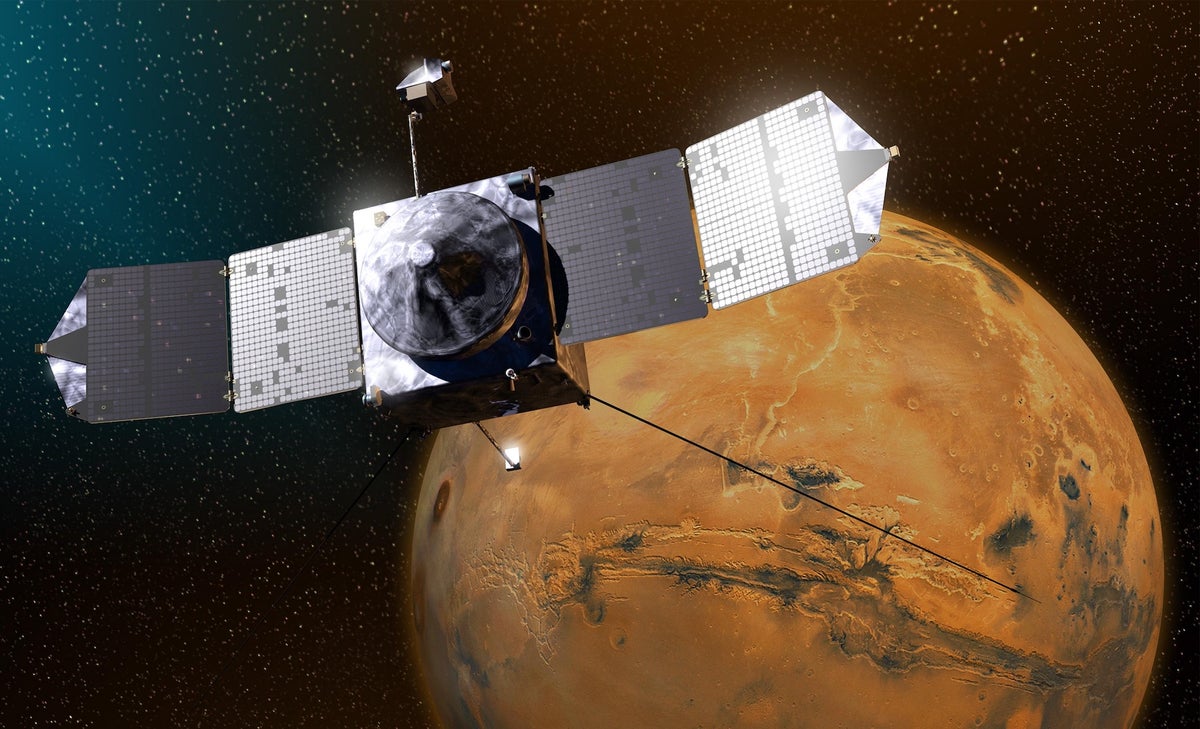
NASA’s MAVEN orbiter, launched in November 2013 and operating at Mars since September 2014, unexpectedly went silent after emerging from behind Mars on Dec. 6 — telemetry prior to occultation showed systems nominal but the Deep Space Network received no signal — leaving engineers troubleshooting a loss of contact. MAVEN is a long-serving asset whose primary science mission is studying the Martian atmosphere and solar-wind interactions and whose secondary role is acting as a relay for surface missions (alongside ESA’s Trace Gas Orbiter, Mars Reconnaissance Orbiter, 2001 Mars Odyssey and Mars Express); its age and recent history (a three-month safe-mode event in 2022 caused by inertial measurement unit problems) underscore the network’s fragility. The outage raises short- and medium-term risks for surface communications and for planned campaigns that depend on orbital relays, including Mars Sample Return, and highlights that proposed next‑generation relay projects — a revived Mars Telecommunications Orbiter received a provisional $700m allocation this year but would be years from launch — remain insufficiently mature to immediately replace failing assets.
NASA’s MAVEN orbiter, launched in November 2013 and operating at Mars since September 2014, stopped transmitting after emerging from behind Mars on December 6; NASA reported telemetry was nominal before occultation but the Deep Space Network received no signal, per a statement posted December 9. MAVEN’s mission is primarily atmospheric science and secondarily a communications relay for surface assets including Curiosity and Perseverance, with ESA’s Trace Gas Orbiter handling the bulk of relays and MRO, 2001 Mars Odyssey and Mars Express providing additional support.
The spacecraft’s age and service history increase systemic risk: MAVEN has already exceeded its one-year design life and experienced a three-month safe mode episode in 2022 caused by inertial measurement unit failures that required an onboard software rewrite. The outage therefore elevates the probability of cascading relay shortages that could affect surface operations and time-sensitive campaigns.
Policy and programmatic context limits short-term remedies: a revived Mars Telecommunications Orbiter received a provisional $700 million allocation this year but remains years from launch, leaving NASA exposed to near- and medium-term capacity shortfalls. The event is a catalyst for potential procurement acceleration and contractor work, but also represents operational risk for missions that depend on orbital relays, notably Mars Sample Return.
AI-powered research, real-time alerts, and portfolio analytics for institutional investors.
Request DemoOverall Sentiment
moderately negative
Sentiment Score
-0.40
