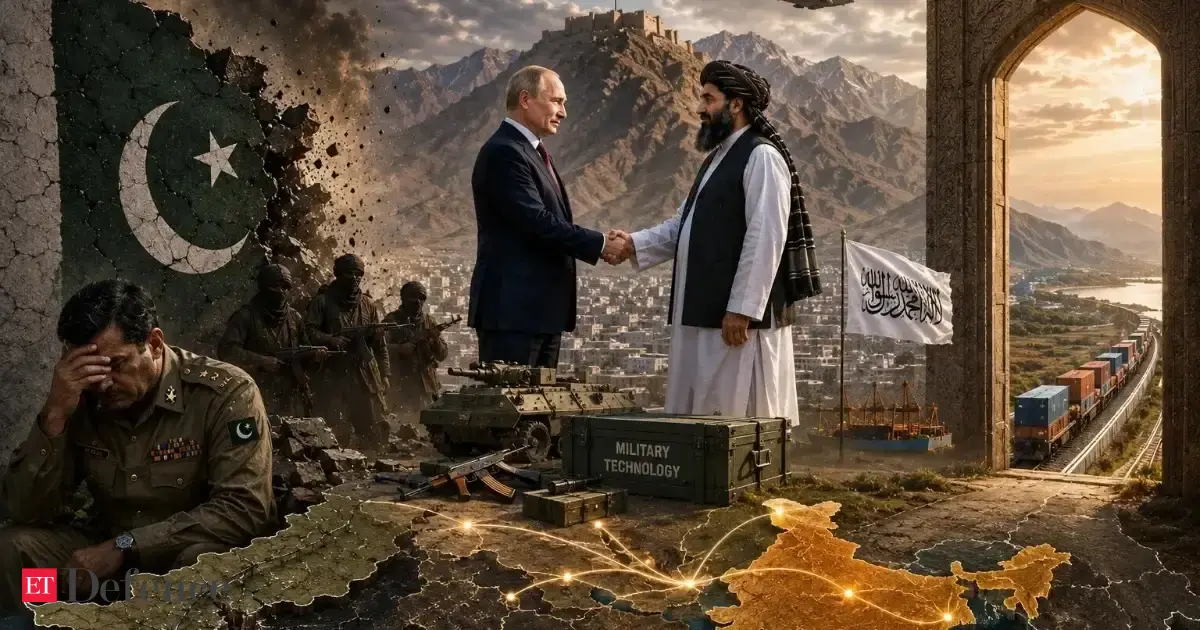
Russia and the Taliban have signed Afghanistan’s first formal defence pact with any foreign nation, covering arms exchanges, technology transfers, licensing agreements and joint development projects. The article argues this realignment weakens Pakistan’s strategic leverage in Afghanistan and creates a more favorable geopolitical backdrop for India, which already maintains pragmatic engagement with Kabul and close ties to Moscow. The broader impact is geopolitical rather than market-specific, but it could influence regional defense and security dynamics across South and Central Asia.
The market implication is not a direct trade in Afghan assets; it is a re-pricing of regional security externalities. A Russia-Kabul defense channel reduces Pakistan’s ability to convert Afghanistan into strategic depth, which should keep Islamabad pinned to higher defense spending, elevated sovereign risk premia, and recurring FX pressure over the next 6-18 months. The second-order effect is that India gets a lower-cost security perimeter in the west without materially increasing its own military burden, which is mildly supportive for Indian risk assets and infrastructure flows tied to Central Asia and Iran corridors.
The most underappreciated beneficiary is not Russia, but Indian logistics and defense-adjacent contractors if the corridor thesis advances from diplomacy to execution. Even incremental de-risking of Chabahar-linked trade or air freight routes improves optionality for India’s northwestern supply chain and reduces dependence on Pakistan-avoidant overland detours. That said, the regime relationship remains fragile: any spike in cross-border attacks, a Taliban-Russia split, or renewed sanctions enforcement on Moscow/Kabul cooperation could stall the thesis within weeks.
Consensus may be too linear on "Pakistan loses, India wins." The more subtle outcome is that a Russia-backed Taliban could become more autonomous from both Pakistan and China, creating a multi-vector balancing act rather than a clean Indian alignment. That limits the upside for any single geopolitical winner trade, but it also lowers tail risk of a full Pakistani proxy capture of Kabul. For investors, the opportunity is in relative-value positioning around defense, Indian infrastructure, and Pakistan country risk rather than headline-chasing directional bets on Afghanistan itself.
AI-powered research, real-time alerts, and portfolio analytics for institutional investors.
Request TrialOverall Sentiment
mildly positive
Sentiment Score
0.15
