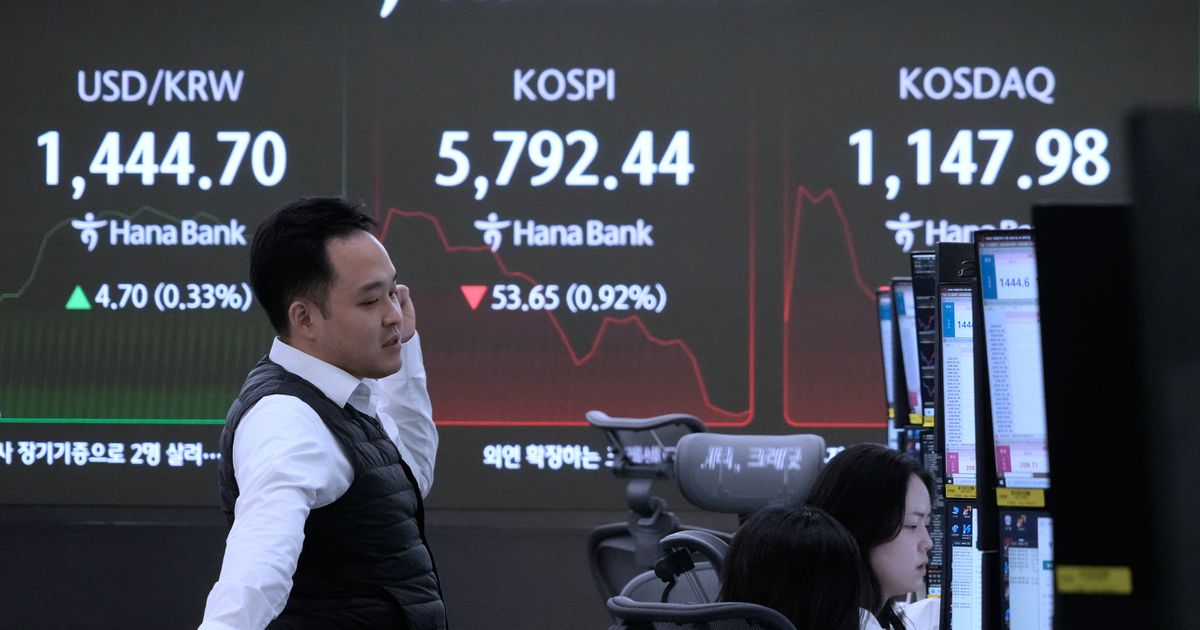
U.S. futures ticked higher as markets digested an AI-driven sell-off and company-specific moves: AMD jumped over 10% premarket after expanding an AI infrastructure partnership with Meta (an investment that could reach ~$100 million with Meta taking a 10% stake), while Home Depot rallied 2.4% after topping Q4 estimates. Attention is focused on Nvidia's profit report due Wednesday amid concerns that heavy AI chip spending by firms like Alphabet and Amazon may not translate into commensurate productivity gains; broader risk drivers include modest crude gains on Middle East tensions, a stronger dollar vs. the yen, and bitcoin sliding ~4.3% to $63,180.
Market structure: The immediate winners are AI-infrastructure pure-plays and adjacent fabs (AMD, memory names like Samsung/SK Hynix) where META’s 10% stake in AMD and a ~$100m ramp signal deeper OEM/customer lock-in; losers are high-capex hyperscalers (GOOGL, AMZN) whose margins may be pressured if AI chip spend is permanent. Pricing power concentrates at scarce accelerator suppliers (NVDA, AMD) and test/equipment vendors (Advantest, Disco), suggesting 6–18 month tightness in advanced node capacity and pricing unless capex expands materially.
Risk assessment: Tail risks include rapid regulatory intervention on AI (U.S./EU safety rules or data localization) or a policy shock from tariff clarification in the SOTU within 48 hours that reshuffles cross-border supply chains; geo-risk (Iran) could lift oil >$80/bbl in 1–3 months, pressuring rates and equity multiples. Short-term (days) volatility will spike around NVDA earnings; medium-term (3–12 months) watch for persistent capex that fails to generate productivity — a deflationary spiral scenario that would compress multiples across consumer and platform names.
Trade implications: Expect elevated IV; use event-driven option structures not directional bets on large cap AI names. Rotate modest real-money into structurally exposed semiconductors (AMD exposure) and defensives that beat consumer weakness (HD) while underweight/hedging hyperscalers with disproportionate AI capex (AMZN, GOOGL) over a 3–12 month horizon. Cross-asset: stronger USD/JPY moves increase non-US equity flows and put modest upward pressure on Treasuries if risk-off; hedge with short-dated T-note protection if oil>+$10 from current levels.
Contrarian angles: The market is overreacting to broad “AI destroys consumers” narratives; short-term profit-taking is likely concentrated in platform stocks that already guided higher capex — infrastructure winners will accrue disproportionate economic rents over 12–36 months. Historical parallel: cloud infrastructure cycle (2012–2016) where initial capex depressed public margins but produced durable moat consolidation; similar outcome favors select infrastructure suppliers rather than broad platform shorts if regulatory action is limited.
AI-powered research, real-time alerts, and portfolio analytics for institutional investors.
Request DemoOverall Sentiment
mixed
Sentiment Score
0.05
Ticker Sentiment
