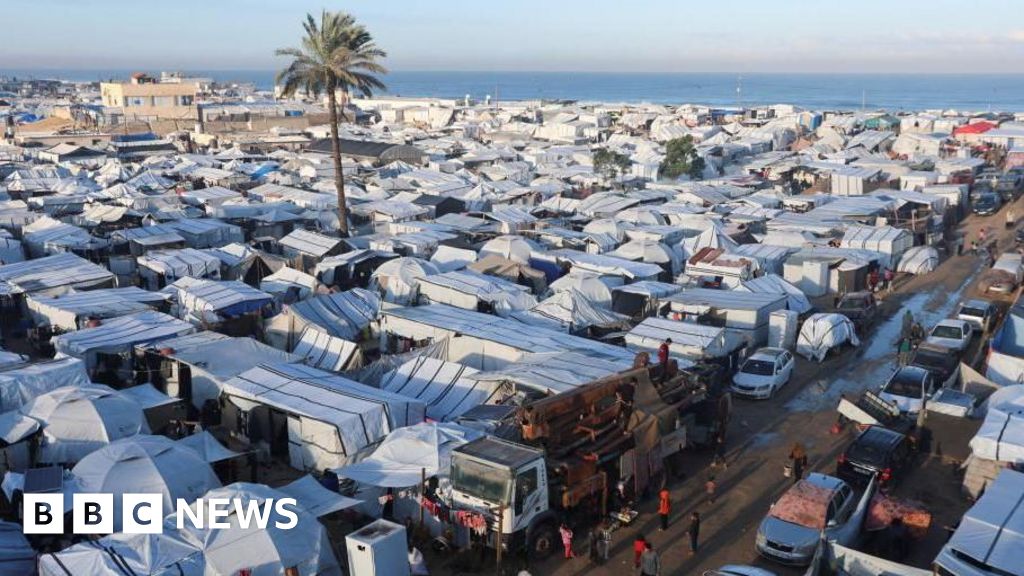
Israeli aircraft struck tents for displaced people in the al-Mawasi area west of Khan Younis, killing five Palestinians — including two children — and injuring dozens, with medics at the Kuwait Field Hospital reporting 32 people treated and bodies recovered from the al-Najaat camp. The Israel Defence Forces said the strike hit a Hamas operative after five IDF soldiers were wounded earlier, and Prime Minister Benjamin Netanyahu vowed to "respond accordingly," marking a reported breach of the ceasefire and raising the risk of renewed escalation that could weigh on regional risk sentiment and safe-haven flows.
Market structure: Immediate winners are defense primes (LMT, RTX, GD) and safe-haven commodities (gold, Brent) due to higher probability of prolonged regional tension; losers are regional equities (iShares MSCI Israel EIS), airlines/cruise operators (AAL, UAL, CCL) with exposure to Middle East routes, and tourism-insensitive EM credit. Pricing power shifts to defense suppliers where multi-year procurement budgets can be accelerated (expect RFP activity and backlog visibility to improve over 3–12 months), while short-term demand for oil could move supply/demand balances +2–8% if shipping routes are disrupted.
Risk assessment: Tail risks include a wider regional war (10–20%+ move in Brent to >$100/bbl within weeks), attacks on Suez/Red Sea raising shipping insurance by 200–400 bps, or US military escalation drawing in NATO — low probability but high impact. Time horizons: days — volatility spikes and flight-to-quality into USD/JPY, gold, USTs; weeks–months — defense revenue recognition and commodity price normalization; quarters+ — budgetary shifts supporting sustained defense capex. Hidden dependencies: Suez/Red Sea insurance, global refinery runs, and US congressional appropriations cadence; catalysts include Hezbollah/IRGC involvement, US naval convoys, and hostage/ceasefire developments.
Trade implications: Tactical plays include 3–12 month longs in large-cap defense (LMT/RTX) via call spreads to cap premium, 1–3% tactical allocation to GLD for 1–3 months as a crash hedge, and 3-month Brent/USO call spreads to capture asymmetric upside if escalation occurs. Relative trades: long LMT vs short EIS (iShares MSCI Israel) to express defense upside and Israel-equity downside; use size limits (2–3% long, 0.5–1% short) and stop-losses (15% adverse move). Entry: execute volatility-sensitive trades within 48–72 hours while IV is elevated; exit or hedge if a stable 30+ day ceasefire is confirmed.
AI-powered research, real-time alerts, and portfolio analytics for institutional investors.
Request DemoOverall Sentiment
strongly negative
Sentiment Score
-0.60
Contrarian angles: The market may overprice persistent oil shock risk — historical parallels (2014 Gaza flare-ups) show oil and gold spikes faded in 6–12 weeks absent broader regional war, creating opportunities to sell overpriced short-dated oil vol if IV > realized vol by >5 vol points. Conversely, Israeli equities (EIS) may be oversold relative to fundamentals and could rebound 10–20% on a sustained ceasefire over 3–6 months; a small, tactical long in EIS after a 15% drawdown could be contrarian. Unintended consequences: accelerated defense spending could strain contractor supply chains, temporarily compressing margins before scale benefits accrue.
