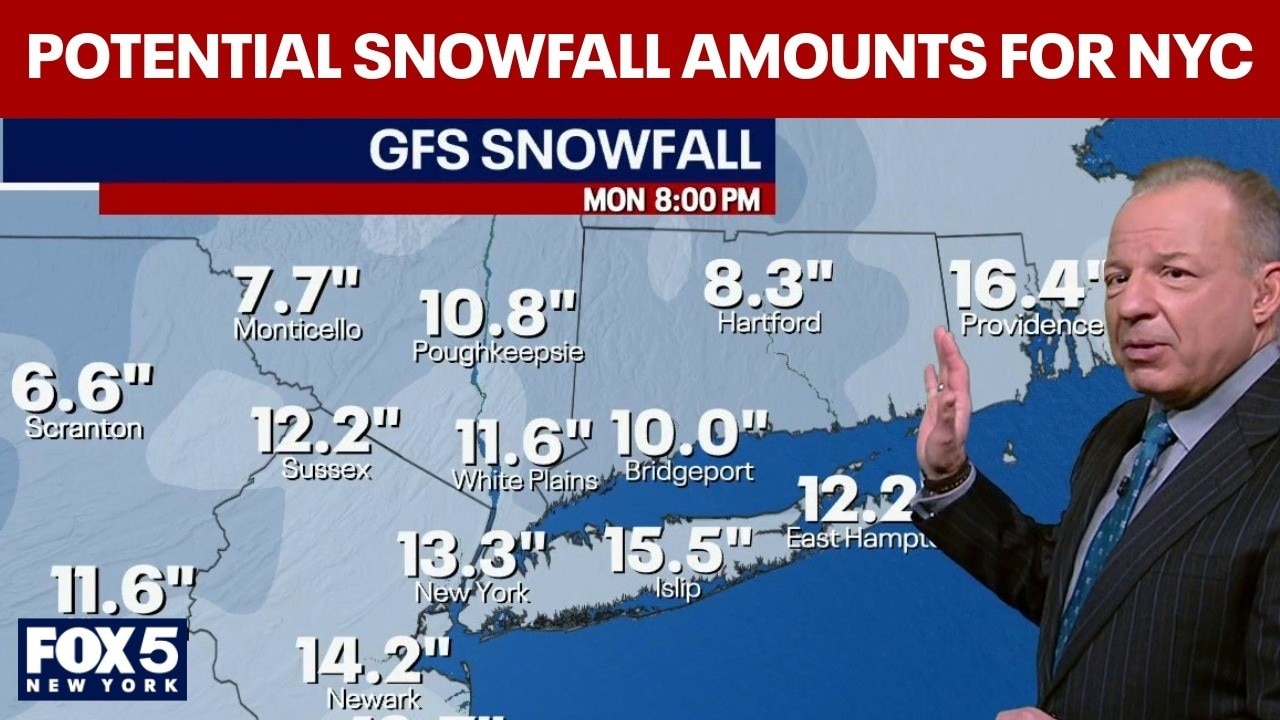
A developing coastal nor'easter could bring accumulating snow to the NYC–Tri-State area Sunday night into Monday morning, with some models (GFS) suggesting 12–16 inches and potential blizzard conditions while others (NAM, Baron) show a more limited or offshore scenario. The storm's track and available cold air remain uncertain, but a significant event would likely disrupt the Monday commute, regional travel and logistics across southern/central New Jersey and NYC, with clearer guidance expected as model runs update through Friday and Saturday.
Market structure: A late-week Nor'easter that produces 6–16 inches in NYC/NJ creates short, concentrated winners—home-improvement (HD, LOW), grocery (WMT, COST), de-icing/salt (CMP) and short-dated natural gas demand—and immediate losers in regional and low-cost carriers (AAL, JBLU, UAL) plus rail/commuter operators. Retailers gain transient pricing power on essentials (expect same-week sales uplifts of 1–3%); airlines face cancellation, yield and ancillary-revenue erosion for 1–5 days. Cross-asset moves will be localized: short-term USD impact negligible, small upward pressure on Henry Hub (+2–5% intramonth if cold persists), and higher short-dated credit spreads for small regional travel issuers.
Risk assessment: Tail risk is a low-probability (≈5–12%) but high-impact blizzard that knocks out power for 24–72 hours across NYC, triggering outsized insured losses, extended transit shutdowns and supply-chain interruptions; that would widen regional muni and short-term corporate spreads by 20–50bp. Immediate window is days (travel disruption); weeks for inventory restocking and retail sales; quarters for any capex or insurance-cycle effects. Hidden dependencies include fuel/logistics (truck/warehouse access), municipal snow-removal capacity, and model-track revisions (GFS vs Euro) that can flip outcomes by 50–100 miles.
Trade implications: Act tactically: in the next 48 hours buy 7–14 day airline puts (AAL, UAL) sized 0.5–1% portfolio each rather than outright shorts; establish 1–3% longs in HD/LOW and 1% in CMP for 1–3 month horizons for storm prep demand. Add a 0.5–1% tactical long in short-dated NYMEX natural gas futures or UNG if model consensus shows sustained cold through week+; implement pair trade long HD (1%) / short AAL (0.75%) to capture asymmetric retail upside vs airline downside.
Contrarian angles: The market often overreacts to early model runs—if Euro/Baron remains offshore by Saturday 12Z, airline put premiums will collapse and HD/WMT jumps will retrace within 3–7 days, presenting a mean-reversion buy opportunity in airlines (buy 2–4 week calls post-confirmation). Historical Nor'easters produced 1–5% equity moves that reversed within two weeks; therefore scale positions small, use options to limit downside, and plan to cut positions within 24–48 hours of confirmed model shift >50 miles offshore.
AI-powered research, real-time alerts, and portfolio analytics for institutional investors.
Request DemoOverall Sentiment
neutral
Sentiment Score
-0.10
