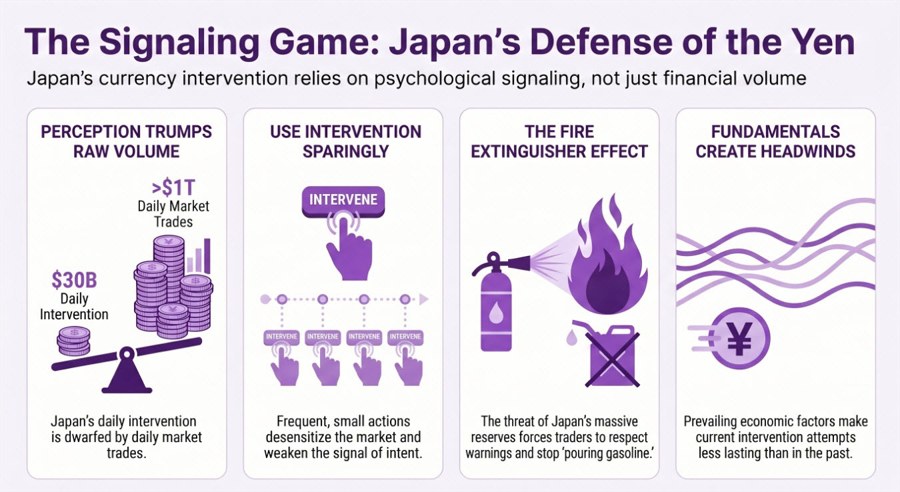
Japan may have only two more three-day FX interventions before November before risking a reclassification from free-floating to floating under IMF guidelines. USD/JPY briefly pushed above 157 and approached 158, then fell more than 1.5% in Asia, suggesting another round of intervention. The piece argues intervention effectiveness depends on sufficient market liquidity and signaling, making repeated action a credibility risk for the MOF/BOJ.
The market is treating Japan’s FX defense as a one-way credibility game: each intervention that fails to materially change trend increases the odds that speculators press harder, not softer. The second-order effect is that the threshold for pain in USD/JPY is now less about spot levels and more about whether authorities can create a believable asymmetry in expected returns; if they cannot, front-end vol should stay bid and leveraged longs become more vulnerable to air pockets rather than orderly retracements.
The more interesting implication is cross-asset. A weaker yen is not just a Japan problem; it is a margin input for global cyclicals that source from Japan and a profit translation tailwind for Japanese exporters, but only until policymakers force a disorderly move lower in USD/JPY. That makes semicap equipment, autos, and high overseas-revenue Japan equities sensitive to the intervention cadence: repeated small interventions are likely to raise hedging costs without breaking the trend, while a larger, credible move could squeeze crowded carry trades and temporarily lift domestic defensives.
The timing matters more than the headline. Acting into thin liquidity may create a larger print, but it also risks being dismissed as a mechanical gap rather than a regime shift, which weakens deterrence and can invite a faster re-test after Tokyo steps away. Over the next 1-3 weeks, the key catalyst is not the next intervention itself but whether the market starts fading rallies sooner and demanding a higher risk premium in USD/JPY options; if that fails to happen, the carry-rebuild will likely continue into the next policy window.
Consensus is probably overestimating the potency of spot intervention and underestimating the power of signaling through options and rate differentials. The cleaner trade is not to chase immediate downside in USD/JPY after a headline, but to position for elevated realized volatility and mean reversion breaks around intervention risk. In other words, this is a vol event with asymmetric tail risk, not a durable directional reversal unless it is paired with a broader shift in rates or explicit policy coordination.
AI-powered research, real-time alerts, and portfolio analytics for institutional investors.
Request DemoOverall Sentiment
mildly negative
Sentiment Score
-0.15
