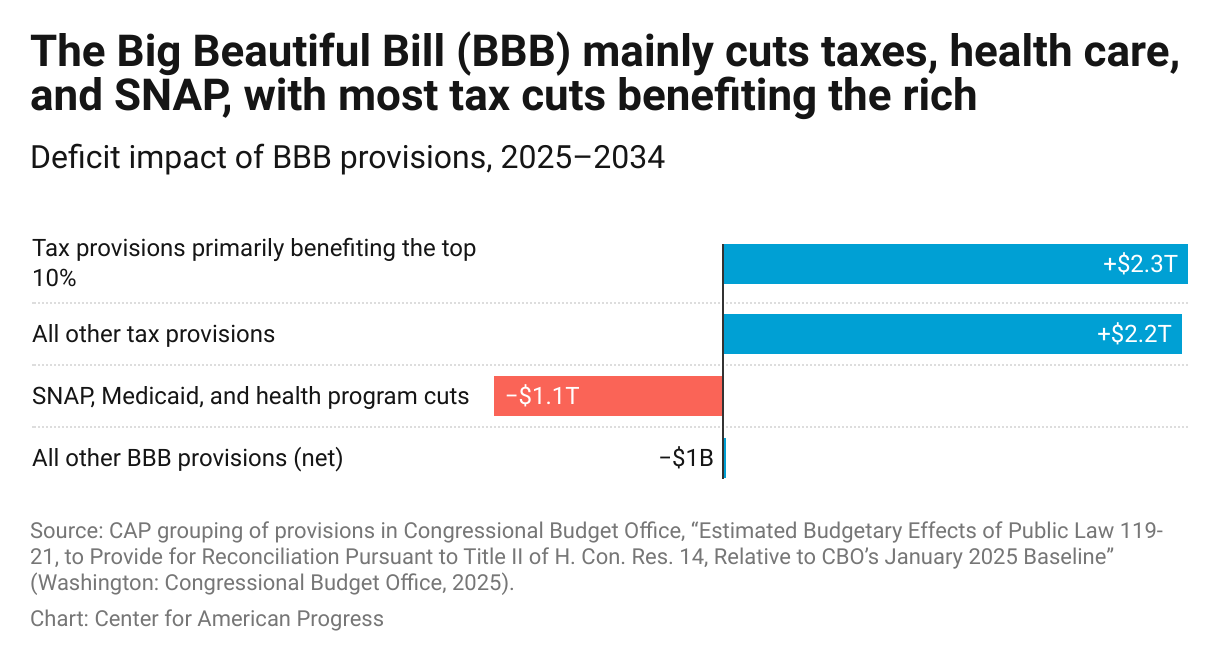
The Big Beautiful Bill (BBB) enacts roughly $4.5 trillion in tax changes over the next decade that, according to CBO/JCT and Center for American Progress analysis, overwhelmingly benefit high-income households—about $2.3 trillion of provisions mainly flow to the top 10% (roughly $1 trillion to the top 1%) while the package also cuts more than $1.1 trillion from SNAP, Medicaid and other programs. Major elements include a permanent cut to the top marginal rate (39.6% to 37%, ~$340bn), a permanent increase in the estate-tax exemption to $15m (~$212bn), continuation and expansion of the pass-through (199A) deduction and capital-gains preferences (QSBS and Opportunity Zones, ~$58bn), $167bn in international tax cuts and $753bn of domestic business tax cuts plus industry-specific breaks. The net effect, the analysis warns, is to raise deficits and channel gains to owners, executives and investors rather than workers, concentrating income at the top and creating sector-specific windfalls (real estate, oil & gas, banks, REITs) with attendant political and distributional risks.
The Center for American Progress’ read of CBO/JCT data finds the Big Beautiful Bill (BBB) enacts roughly $4.5 trillion of tax changes over the next decade while concentrating benefits at the top: ~ $2.3 trillion of provisions mainly flow to the top 10 percent (including ~$1 trillion to the top 1%), and the package offsets this with more than $1.1 trillion in cuts to SNAP, Medicaid and other programs used by the poorest Americans. Major line items cited include a permanent top marginal rate cut from 39.6% to 37% (~$340bn through 2034), a permanent estate-tax exemption increase to $15m per person (~$212bn), $753bn of domestic business tax cuts, $167bn in international profit tax cuts, and targeted capital gains preferences (Opportunity Zones $41bn; QSBS expansion $17bn).
Policy design details show distributional concentration: the pass-through (199A) deduction delivered 87% of its 2022 benefit to the top 10% and half to millionaires, Treasury research attributes most QSBS gains to >$1m earners, and sector-specific breaks favor banks, REIT owners, oil & gas, distilled spirits and space-related investors. The analysis flags limited evidence that these provisions lift worker pay and notes that many cuts primarily increase owners’ and executives’ after-tax income.
Implications for markets and policy include a likely outsized near-term earnings boost for owners and investor-heavy sectors, a structurally higher deficit profile that raises political and regulatory risk of future tax reversals, and a distributional shift that may depress low-income consumer purchasing power; investors should therefore weigh sector-level upside against heightened policy and social backlash risks and monitor actual corporate investment and hiring responses to the incentives.
AI-powered research, real-time alerts, and portfolio analytics for institutional investors.
Request DemoOverall Sentiment
strongly negative
Sentiment Score
-0.65
Ticker Sentiment
