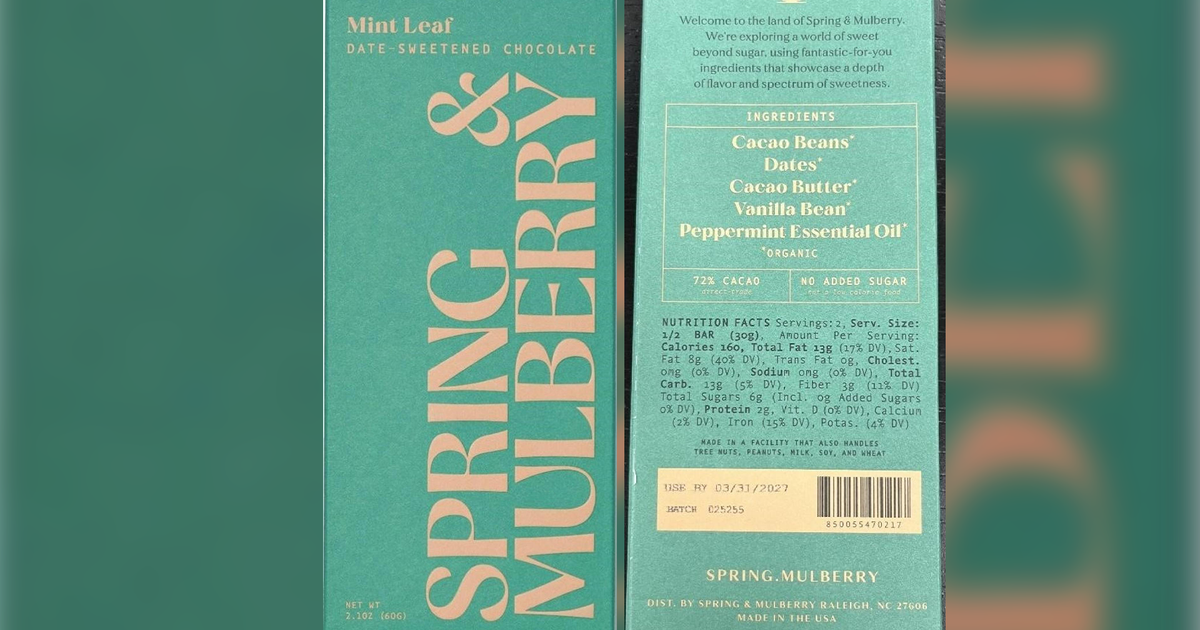
Spring & Mulberry voluntarily recalled its Mint Leaf chocolate bars (teal box, lot #025255) after routine third‑party testing flagged possible Salmonella contamination; the product was sold online and in select retailers nationwide since Sept. 15. No illnesses have been reported; the company is asking customers to dispose of the product and is offering refunds via recalls@springandmulberry.com, making this primarily a reputational and consumer‑safety event with limited near‑term market implications.
Market structure: This recall is a small, idiosyncratic shock that benefits large, branded confectioners (MDLZ, HSY) and national retailers (WMT, AMZN) via shelf-substitution while directly harming the private artisanal maker and comparable small-cap naturals. Expect incremental short-term share gains for incumbents of ~0.1–0.5% category volume over 2–8 weeks and improved promotional leverage; cocoa and broader commodities are unaffected. Cross-asset impact is minimal: potential basis widening in high-yield/credit for small food producers (+10–30bps if contagion appears) but no meaningful FX or sovereign bond moves.
Risk assessment: Tail risk is a multi-site outbreak or co-packer implication triggering FDA enforcement and class actions—this could cause 5–15% equity drawdowns for implicated small names and 1–3% downside for category leaders. Immediate (0–7 days): reputational noise and refund costs; short-term (weeks): retailer delistings and lost shelf space; long-term (quarters): brand trust erosion if repeated. Hidden dependency: shared co-packers and ingredient suppliers can create contagion across private and public naturals within 30–90 days. Key catalysts: confirmed illnesses, FDA inspection findings, and retailer delistings.
Trade implications: Favor low-conviction longs in MDLZ/HSY (1–2% portfolio) and targeted short/put exposure to HAIN (0.5–1%) to express clean-label contagion risk; use 60–90 day call spreads on MDLZ/HSY and 30–90 day puts on HAIN to keep defined risk. Pair trade: long MDLZ, short HAIN sized to neutral beta; enter within 5 trading days, take profits at +5–7% or cut losses at -4%. Monitor FDA updates for 30 days as primary trigger to scale positions.
Contrarian angles: Consensus may underweight the co-packer contagion vector—one confirmed co-packer finding would reprice multiple small naturals rapidly, so downside is asymmetric for small caps. Conversely, the market may over-penalize public naturals on a single private-brand recall; if no illnesses or retailer exits within 60 days, expect mean reversion and possible short-cover rallies. Historical parallel: 2013–2014 natural-food recalls (e.g., Hain) show prolonged underperformance followed by sharp rebounds when no systemic issue was found; size positions accordingly and use tight stops (6–8%).
AI-powered research, real-time alerts, and portfolio analytics for institutional investors.
Request DemoOverall Sentiment
mildly negative
Sentiment Score
-0.25
