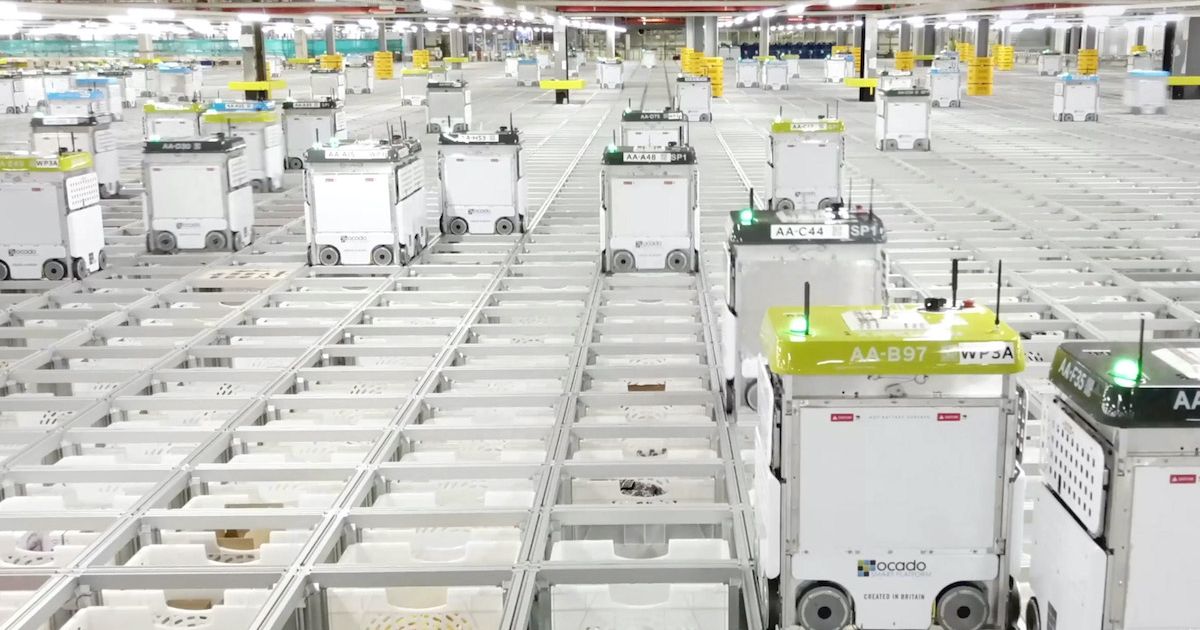
Ocado shares fell about 10% after Canadian supermarket Sobeys announced it will close its robot-run customer fulfilment centre in Calgary and keep its Vancouver site paused, following Kroger's closure of three CFCs late last year. Ocado will receive a one-off £18m termination payment this year but expects fee revenue to drop by £7m; the £18m is materially smaller than the roughly $85m per CFC Kroger paid, prompting concerns about the fragility of presumed lifetime revenues. The group reiterated its target of cash breakeven in 2026, while analysts warned the closures are another setback for Ocado's overseas automation model.
Market structure: This outcome clearly benefits low-capex, store-led grocers and 3PL/outsourced fulfilment providers while hurting robotics integrators and platform vendors—Ocado (LSE:OCDO) is the direct loser (shares -10% on news). The fragility of “lifetime” CFC revenues reduces Ocado’s pricing power and raises the effective customer churn rate; expect contractors and opportunistic integrators to bid for remaining business, pushing down future contract pricing by an estimated 10–20% vs prior models.
Risk assessment: Near-term tail risks include a cascade of additional CFC closures (50% probability within 12 months for mid-sized clients) and Ocado missing its 2026 cash-breakeven target (material miss >£50m). Immediate (days) risk is volatility and analyst downgrades; short-term (weeks/months) is revenue downgrades and higher cost-to-serve; long-term (years) is structural repricing of automation contracts and concentration risk from a few large customers.
Trade implications: Tactical short OCDO exposure is warranted now (see specifics below) and pair trades short OCDO vs long Walmart (NYSE:WMT) or Costco (NASDAQ:COST) to express vendor weakness vs retail resilience. Options: buy 3-month puts or put spreads on OCDO to monetize elevated implied vol; rotate sector exposure from automation/robotics into defensive grocery and 3PL names (WMT, COST, UPS) over 1–3 months.
Contrarian angles: The market may be overfitting two client exits into permanent secular failure—£18m termination and £7m fee loss are manageable relative to group revenue if no further losses occur, so a disciplined dip-buy if OCDO falls >20% from today and management reaffirms 2026 targets could produce outsized returns. Historical parallels (technology rollouts where early clients pull back) show survival for vendors who restructure contracts to SaaS/licensing—this is a plausible recovery path if Ocado cuts fixed-cost exposure within 6–12 months.
AI-powered research, real-time alerts, and portfolio analytics for institutional investors.
Request DemoOverall Sentiment
strongly negative
Sentiment Score
-0.62
Ticker Sentiment
