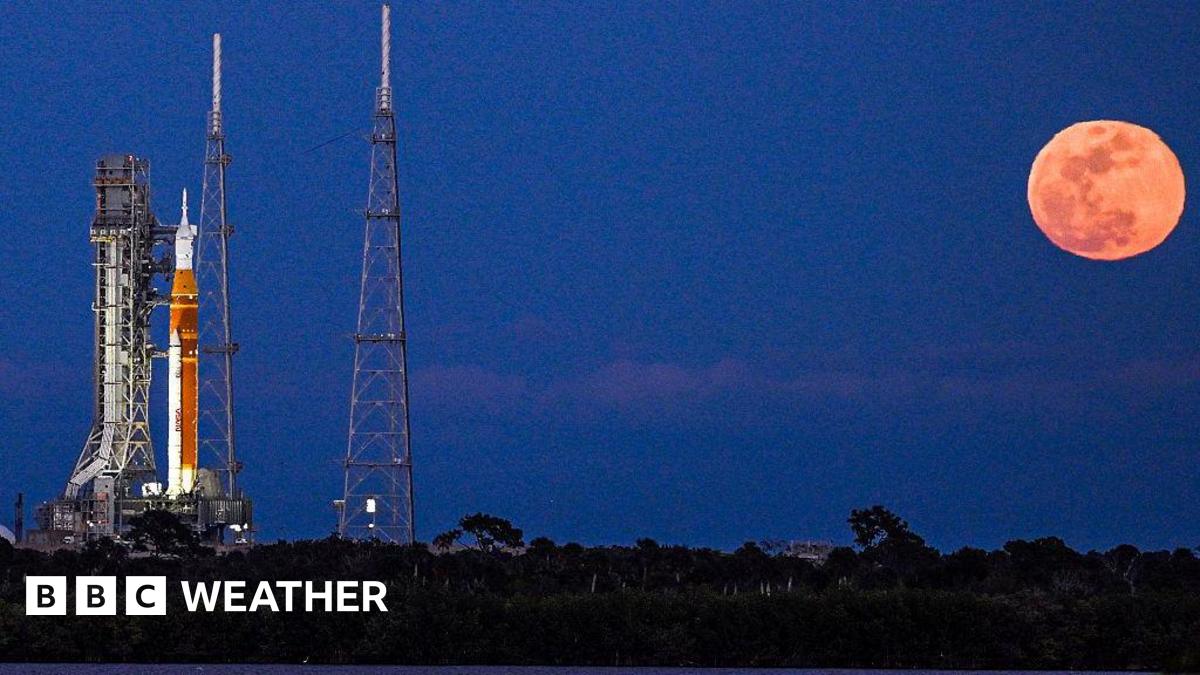
Launch window for Artemis II opens 1 April at 18:24 EDT; the SLS/Orion stack contains nearly 750,000 gallons of propellant and faces risk from convective cumulus clouds, showers, strong winds and both natural and rocket‑induced lightning which could scrub the launch. 2–6 April are backup launch days, the 45th Weather Squadron is forecasting and monitoring Cape Canaveral, North Atlantic recovery areas and solar activity, and historically nearly half of scrubbed launches are due to unsafe weather.
Near-term meteorological uncertainty acts like a binary gating factor for mission cadence that cascades through a fixed-cost supply chain: a single multi-day scrub window can convert short-term O&M costs into meaningful margin compression for kit integrators and test-service providers. For firms with concentrated dependence on a small number of major government milestones, a 1-3 month schedule slip typically defers revenue recognition and can swing quarterly margins by multiples of their underlying organic growth rates (we estimate 3-7% EBITDA volatility for mid-sized aerospace subcontractors per missed major launch).
Separately, persistent weather risk increases the value of high-cadence Earth-observation and nowcasting data products because operators will pay to shrink T-0 uncertainty; that shifts procurement from episodic consultancy to subscription feeds and favors scalable, low-latency data providers over legacy model shops. Insurers and range operators also recalibrate pricing and capacity — expect underwriting capacity for crewed missions to tighten first, then broaden to other commercial payloads as actuarial assumptions are updated.
The consensus framing treats weather as a short-lived operational nuisance; the more durable impact is strategic: repeated delays accelerate investment in distributed launch sites, mobile recovery assets, and robust simulation tooling, creating multi-year addressable markets for satellite data, autonomous recovery vessels, and advanced atmospheric models. Near-term catalysts to watch that would reverse this trade are a sustained period of benign weather across multiple launch windows or a rapid scaling of commercial launch capacity that absorbs overflow demand within 6-12 months.
AI-powered research, real-time alerts, and portfolio analytics for institutional investors.
Request DemoOverall Sentiment
neutral
Sentiment Score
0.00
