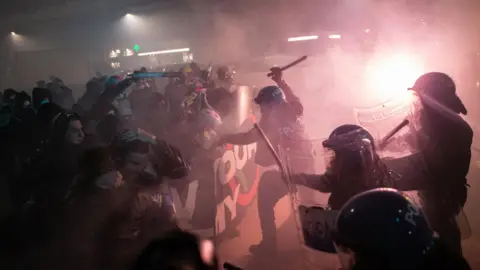
Six people were arrested after clashes between protesters and police in Milan on the opening day of the Winter Olympics, as thousands demonstrated against cost-of-living and the Games' environmental and social impacts; some protesters used fireworks and stones and police deployed water cannon. Authorities also reported suspected sabotage on northern rail lines — including a fire between Bologna and Venice, severed electric cables, a track switch set alight near Pesaro and a rudimentary explosive device — causing delays before services were restored. The government has fast-tracked a security package after violent unrest in Turin that permits pre-emptive detention of suspected troublemakers for up to 12 hours, raising regulatory, security and operational risk for transport and travel operators during the Games.
Market structure: Short-term winners are security and defense equipment providers (e.g., Leonardo - LDO.MI) and private security contractors as governments fast-track spending; losers are travel & leisure operators, regional rail/transport operators, and Italy-centric tourism plays (FTSE MIB travel names) which face lower visitation and higher insurance/operational costs over the next 2–6 weeks. Pricing power shifts toward suppliers of surveillance, rail-safety hardware and emergency services; rail operators face higher O&M budgets and possible service penalties, compressing margins by an incremental ~1–3% if disruptions continue for months.
Risk assessment: Tail risks include escalation to nationwide transport sabotage or sustained strikes that widen BTP-Bund spreads by >150–200bp, triggering material FX weakness in EUR-USD (>2–3%) and forcing ECB/tail-risk premium repricing within 1–3 months. Immediate (days) impact will be travel disruptions and localized equity/volatility spikes; short-term (weeks) sees tourism revenue miss for Olympics window (through 22 Feb), while long-term (quarters) the political tilt toward security-heavy regulation can reallocate public capex toward defense/security vs social spending. Hidden dependencies: supply-chain bottlenecks from northern Italy manufacturing (auto, components) could transmit to EM and commodity order flows if rail is disrupted >1 week.
Trade implications: Tactical longs: establish a 2–3% notional long in Leonardo (LDO.MI) to capture near-term security budget acceleration and buy 1–2% notional of 3–6 month BTP protection (CDS or long Bunds) if BTP-Bund spread >150bp. Shorts/hedges: 2–4% short/put protection on Italy-focused ETFs (EWI) or travel names (Ryanair RYA.I, IAG IAG.L) for downside through end-Feb; implement 2–4 week put spreads (buy 5% OTM, sell 10% OTM) to control premium while capturing volatility. Sector rotation: reduce cyclicals/tourism exposure by 3–5% and reallocate into defense, utilities (ENEL.MI) and global logistics names with non-Italian hubs.
Contrarian angles: Consensus focuses on headline disruption; underappreciated is potential re-rating of Italian defense/security equities and domestic construction contractors if public capex shifts—this could produce 15–25% upside over 6–12 months for select names if legislation secures multi-year spend. Overreaction risk: a knee-jerk 5–10% selloff in Italy equities could present a buying window—add risk in tranches when BTP-Bund spread compresses back by >50bp from peak or after Olympics (post 22 Feb) when operational disruptions resolve. Monitor: BTP-Bund spread, FTSE MIB vols, and rail incident count daily; if incident rate >3 in a week, widen hedges immediately.
AI-powered research, real-time alerts, and portfolio analytics for institutional investors.
Request DemoOverall Sentiment
moderately negative
Sentiment Score
-0.35
