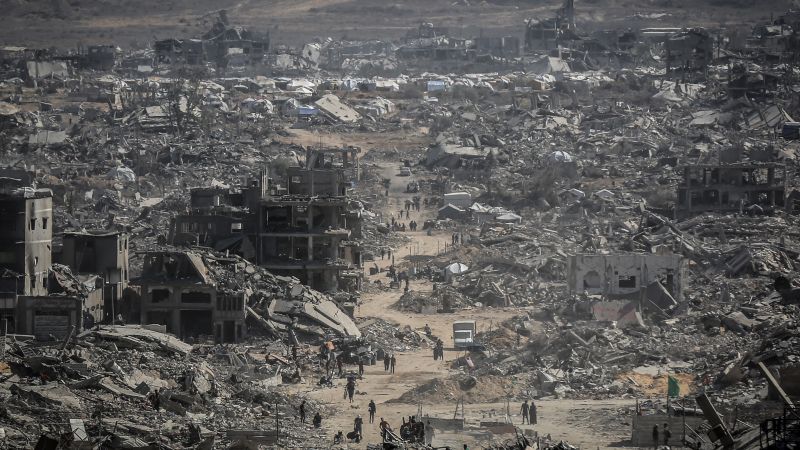
Following a Trump-brokered ceasefire, Gaza faces an unprecedented humanitarian crisis and widespread devastation, with over 80% of buildings destroyed and infrastructure collapsed, necessitating an estimated $70 billion for reconstruction. A significant security vacuum has emerged, allowing Hamas to reassert control amidst an undefined long-term governance plan and an international security force still in nascent stages. This situation presents substantial geopolitical instability and financial risk, with promised international funding for recovery yet to materialize, underscoring the immense and uncertain challenges for regional stability and any future investment.
The Gaza Strip faces an unprecedented humanitarian and infrastructural catastrophe following a recent ceasefire, with over 80% of its buildings damaged or destroyed and its infrastructure, including water and sanitation systems, in a state of collapse. Local health officials report nearly 68,000 fatalities, and the United Nations Development Program estimates 55 million tons of debris require removal, indicating a reconstruction cost of approximately $70 billion, with $20 billion needed in the first three years for basic functions alone. This scale of destruction presents an extremely negative outlook for any immediate economic recovery or stability.
A significant security vacuum has emerged post-ceasefire, allowing Hamas to reassert control through public executions and consolidation of power in areas where Israel has withdrawn. This re-emergence of Hamas, coupled with an undefined long-term governance plan and the nascent formation of an international security force, creates profound geopolitical instability and uncertainty regarding future security arrangements. The 20-point Trump-brokered proposal for disarming Hamas and establishing a technocratic Palestinian body remains largely unimplemented in its critical second phase.
Economically, Gaza is experiencing severe distress, marked by famine in parts of Gaza City and extreme price inflation, such as onions costing 400 times pre-war levels. While aid flow has increased since the ceasefire, it remains insufficient, with the UN warning that 600 trucks daily are a "drop in the ocean." The promised international funding for reconstruction has yet to materialize, leaving the population heavily reliant on aid and facing a complete collapse of its economy, with few jobs and limited access to cash.
This situation underscores immense and uncertain challenges for regional stability, with a high risk of ceasefire breakdown and continued conflict. The lack of a clear governance framework, coupled with the vast scale of destruction and humanitarian crisis, suggests a prolonged period of instability and an environment unsuitable for conventional investment. The reliance on external aid and political will for reconstruction funding introduces further volatility.
AI-powered research, real-time alerts, and portfolio analytics for institutional investors.
Request DemoOverall Sentiment
extremely negative
Sentiment Score
-0.90
