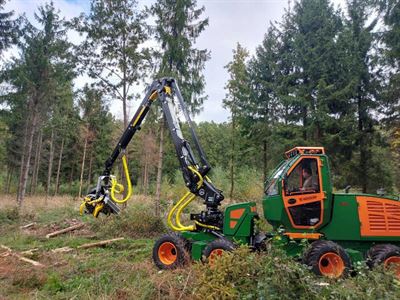
Kesla Oyj has expanded its small harvester crane lineup with new HF variants of the 6H series, including the KESLA 671H (6.7m reach) and the telescopic 685H (8.5m reach); the HF models add a horizontal mounting flange (8×175 mm bolt pattern), 275° slewing range and 17 kNm slewing torque to improve compatibility with lightweight thinning harvesters. The product update leverages a robust base from an 8-tonne-meter forwarder crane and has drawn manufacturer interest, supporting Kesla’s market positioning alongside its KESLA 16RH and 18RH-II heads; the company reported 2024 turnover of €44.3m (53% exports) and ~232 employees, though the announcement is operational/product-focused and likely to have limited immediate market impact.
Market structure: Winners are Kesla (Helsinki: KESLA) and OEMs focused on lightweight thinning (e.g., Sampo‑Rosenlew partners) because the 6HF lowers integration cost via a standard 8×175 mm flange; losers are incumbents selling non‑compatible small cranes and aftermarket retrofit vendors. The competitive effect is niche share wins rather than pricing power — expect mid‑single‑digit margin uplift for Kesla if OEM adoption grows to capture 5–10% of EU lightweight harvester builds within 12–24 months. Cross-asset impact is minimal but slightly positive for cyclical industrials (XLI) and timber/forestry equities (WOOD); negligible sovereign bond effect, small support for EUR if export momentum proves durable.
Risk assessment: Tail risks include a >30% drop in timber prices or restrictive EU forestry/regulatory action that collapses thinning capex, and operational risk from warranty/service issues with new HF mounting; probability low but impact high. Timeline: immediate sentiment lift (days), order validation needed within 3–6 months, and true revenue/earnings impact measurable over 12–36 months. Hidden dependencies: ~53% export exposure, OEM adoption cadence, and limited production scale (232 employees) create execution risk. Key catalysts: signed OEM supply contracts, ≥€2–3M purchase orders, or disclosure of multiunit pilot fleets in next 90 days; absence of those reverses momentum.
Trade implications: Direct play — small, size‑constrained long in KESLA (0.5–1% portfolio) to capture product adoption optionality; complement with tactical 9–12 month DE (Deere) call spread to play broad forestry capex recovery (target +10–20% move). Pair trade — long KESLA vs short PONSSE (Helsinki: PONSSE) sized 1:1 if within 90 days Kesla secures OEM exclusivity; unwind if no orders. Options — consider buying 9–12 month DE calls and selling +15% calls to fund cost; avoid illiquid options on KESLA. Rotate 1–3% from generic industrials into timber/forestry (WOOD) over next 6 months.
Contrarian angles: Consensus will underweight the importance of flange compatibility — a small mechanical standard can accelerate OEM selection and aftermarket lock‑in; however markets often overestimate short‑term revenue from a single product update given Kesla’s €44.3m turnover. Historical parallels: niche product wins in forestry (PONSSE product cycles) led to outsized share gains over 24–36 months, not quarters. Unintended consequences include post‑sale service burden and potential cannibalization with Kesla’s forwarder crane business, which would compress margins if not managed.
AI-powered research, real-time alerts, and portfolio analytics for institutional investors.
Request DemoOverall Sentiment
mildly positive
Sentiment Score
0.30
