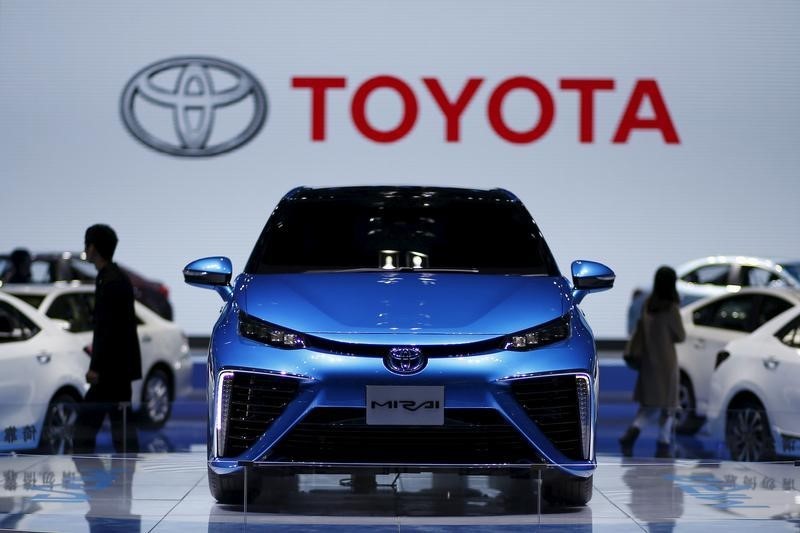
Toyota's annual operating income fell to 3.78 trillion yen from 4.79 trillion yen, and Q4 operating income nearly halved to 569.4 billion yen, as U.S. tariffs squeezed margins despite stronger sales. The company forecast fiscal 2027 operating income of 3.0 trillion yen, well below Bloomberg estimates of 4.61 trillion yen, citing a likely inability to absorb additional Middle East conflict costs. Full-year vehicle sales rose to 11.3 million units and Toyota maintained a 95 yen per share dividend, but the guidance miss and tariff/geopolitical pressure are negative for shares.
TM looks less like a clean idiosyncratic earnings miss and more like a margin-transfer story: tariffs and Middle East risk are both external shocks that Toyota cannot offset quickly, which means the pressure is likely to persist for multiple quarters rather than one print. The key second-order effect is that Toyota’s scale and hybrid mix are usually a buffer, so when even this franchise has to cut guidance, it argues for broader compression in Japan auto sector multiples as investors reassess how much pricing power the industry really has in a high-cost trade regime.
The bigger market implication is that supply-chain winners are not the obvious OEM peers but upstream and adjacent names with pricing leverage over parts, logistics, and commodity inputs. If Middle East volatility keeps freight and insurance costs elevated, import-heavy automakers and suppliers with lower localization in North America should see the most immediate margin pressure, while US-based suppliers and domestic production footprints gain relative advantage over 6-12 months. This is also a subtle warning sign for global consumer demand: auto is a high-ticket discretionary category, so softer unit guidance can be an early read-through for broader durable-goods elasticity if financing conditions remain tight.
The catalyst path is asymmetric. In days, the market can overreact to headline geopolitics; in months, the real driver will be whether tariff-related costs get passed through without volume damage and whether conflict-driven input costs normalize. A reversal likely needs either a de-escalation in the Gulf or concrete tariff relief, neither of which is in the base case, so the risk/reward favors fading rallies in exposed OEMs rather than trying to catch a bottom immediately.
Contrarian angle: the consensus may be underestimating Toyota’s ability to defend relative share through hybrids even if absolute margins compress. That argues for being short the industry beta rather than making a blunt short on Toyota alone, because the company’s product mix and balance sheet can make it a relative winner inside a structurally challenged sector even while earnings disappoint.
AI-powered research, real-time alerts, and portfolio analytics for institutional investors.
Request DemoOverall Sentiment
moderately negative
Sentiment Score
-0.40
Ticker Sentiment
