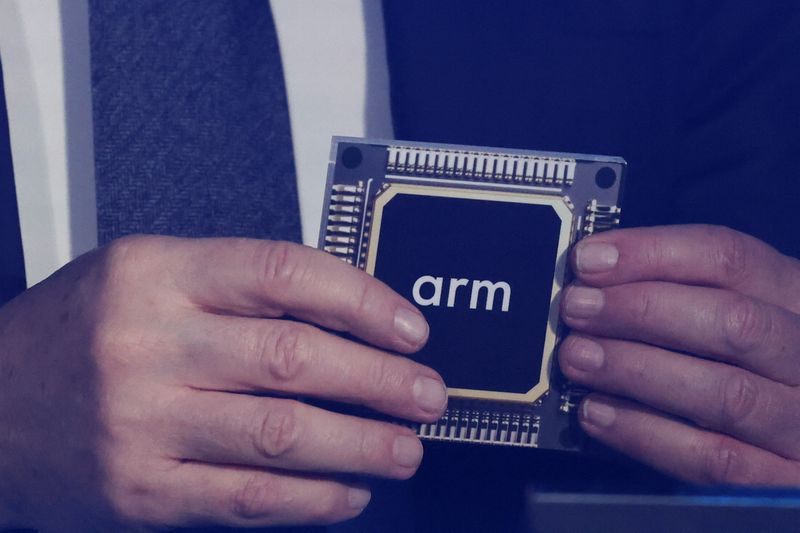
Shares of Arm Holdings jumped 13% premarket after bullish analyst notes and outlook revisions. Raymond James upgraded to Outperform with a $166 price target and projects FY28 EPS of $3 and FY31 EPS of $9; Wolfe Research estimates the AGI CPU could generate $15 billion of revenue by FY31 and positions Arm in a >$100bn merchant CPU market. Arm’s new AGI CPU (co-developed with Meta) is said to deliver ~2x x86 performance in high-end reference setups and has confirmed deployments with multiple customers including OpenAI, Cerebras, Cloudflare, F5, SAP and SK Telecom, supporting a materially larger long-term opportunity.
A move by a core-IP provider into merchant CPU products shifts its revenue mix from steady licensing to lumpy product sales and creates a new chokepoint at foundries and packaging partners; expect gross-margin volatility to increase near-term as wafer allocation and NRE timing dominate economics. That shift also changes bargaining leverage: design wins with hyperscalers will lock in software stacks and amortize R&D, but small/one-off customers will face multi-quarter lead times and potential price volatility for wafers and advanced packaging.
Second-order winners are vendors that sit between cores and data‑center traffic—smart‑NICs, interconnect/CXL memory suppliers, OS and compiler toolchain vendors—because heterogeneous node designs increase demand for orchestration and NIC offload. Conversely, incumbents whose moat relies on a vertically integrated x86 stack suffer a double whammy: share erosion plus margin compression if they must price to hold volume while their foundry partners reallocate capacity.
Key risks are execution and ecosystem timing rather than product performance: software maturity (compilers, container/VM optimization), thermal/board-level integration, and foundry cadence can each introduce 6–36 month slippage. Market positioning is currently pricing optionality; a binary pattern emerges where successful multi‑gen partner commitments unlock outsized multiple expansion, but any meaningful customer deferral or benchmark inconsistency will produce equally sharp downside.
For portfolio construction, target asymmetric structures that monetize the convex upside of a multi‑year adoption cycle while limiting near‑term execution risk. Use pairs and option spreads to express the secular thesis without carrying single‑name gamma into macro-driven drawdowns, and size positions to reflect the 12–36 month uncertainty window rather than the headline enthusiasm of a single print.
AI-powered research, real-time alerts, and portfolio analytics for institutional investors.
Request DemoOverall Sentiment
strongly positive
Sentiment Score
0.80
Ticker Sentiment
