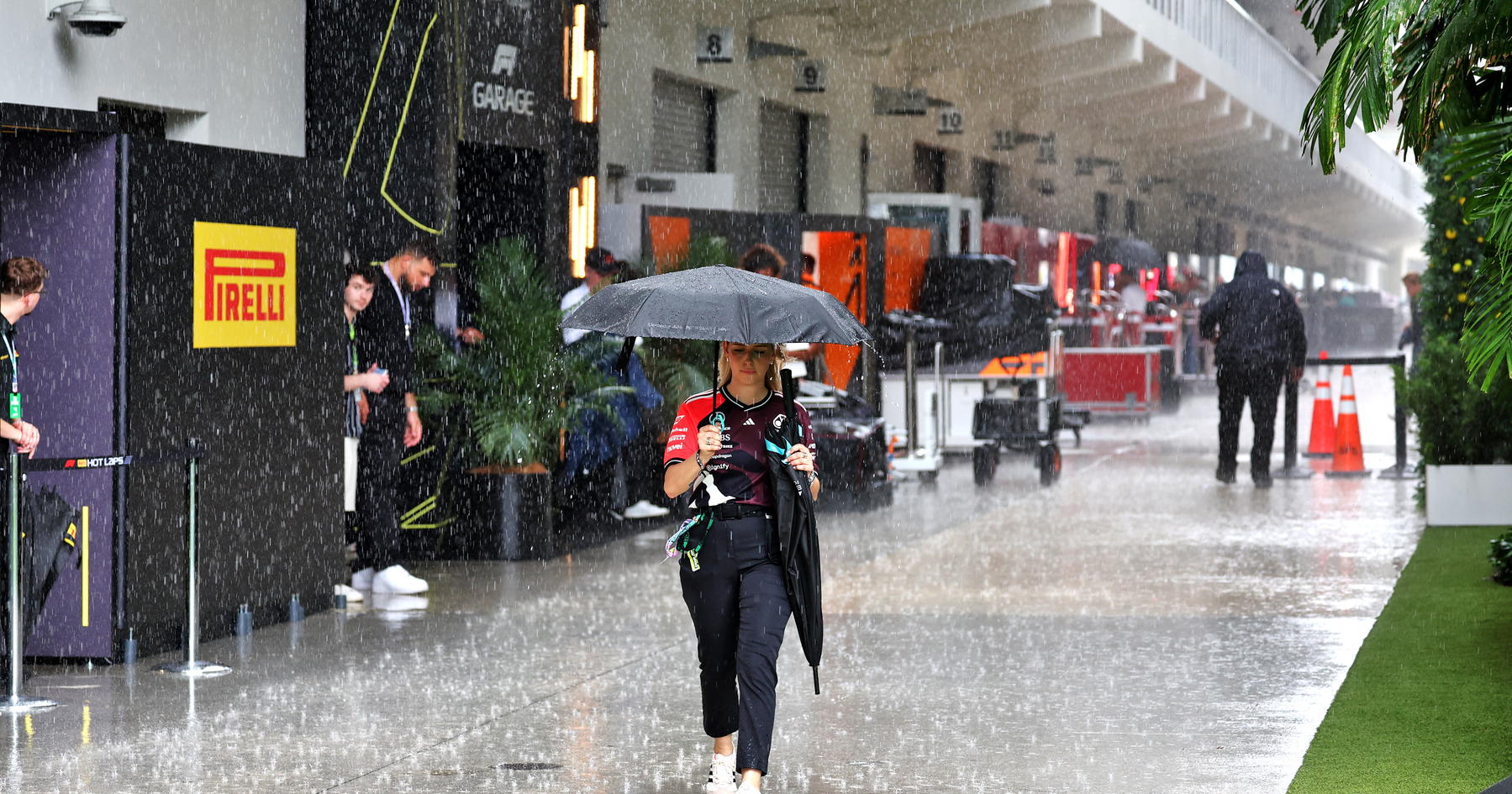
The FIA says it is monitoring thunderstorms that could disrupt Sunday's Miami Grand Prix, with heavy rain projected and a US law requiring outdoor events to halt if lightning is approaching. While Friday and Saturday are expected to be hot and sunny, the FIA says it has a contingency plan and is confident the race can stay on schedule. If needed, it can also adjust the start time, as it did at the 2024 Brazilian Grand Prix.
The important market takeaway is not the weather itself but the operational asymmetry created by the thunderstorm rule: a late-day race delay has very limited downside for the franchise value of the event, but it materially increases volatility for a narrow set of nearby businesses that monetize a fixed Sunday window. The highest-probability impact is a reshuffling of timing rather than cancellation, which means any disruption is more likely to compress hospitality, transport, and local event spend into a smaller time bucket than fully erase it. Second-order effects matter more than the headline. A delay tends to favor organizers and broadcasters with flexible programming, while pressuring local travel operators, rideshare demand, and premium venue operators that rely on predictable arrival/departure flows. If lightning protocols force evacuation, the loss is not just race revenue for a few hours; it can spill into labor overtime, security costs, and refund friction, which hits margins for operators with thin event-day economics. The contrarian read is that the market usually overestimates cancellation risk and underestimates schedule elasticity. If officials can move the start even by 60-120 minutes, much of the direct revenue impact is merely deferred, not destroyed. That makes a bearish knee-jerk on adjacent leisure and transport names vulnerable unless radar-driven conditions persist into the published start window; the real tail risk is a multi-hour delay that collides with spectator exit timing and triggers a broader logistics bottleneck. For investors, the setup is more attractive as a short-duration volatility trade than a directional weather bet. The catalyst window is 24-48 hours, and the edge comes from exploiting overreaction in event-sensitive equities rather than making a broad market call on F1 demand.
AI-powered research, real-time alerts, and portfolio analytics for institutional investors.
Request DemoOverall Sentiment
neutral
Sentiment Score
-0.05
