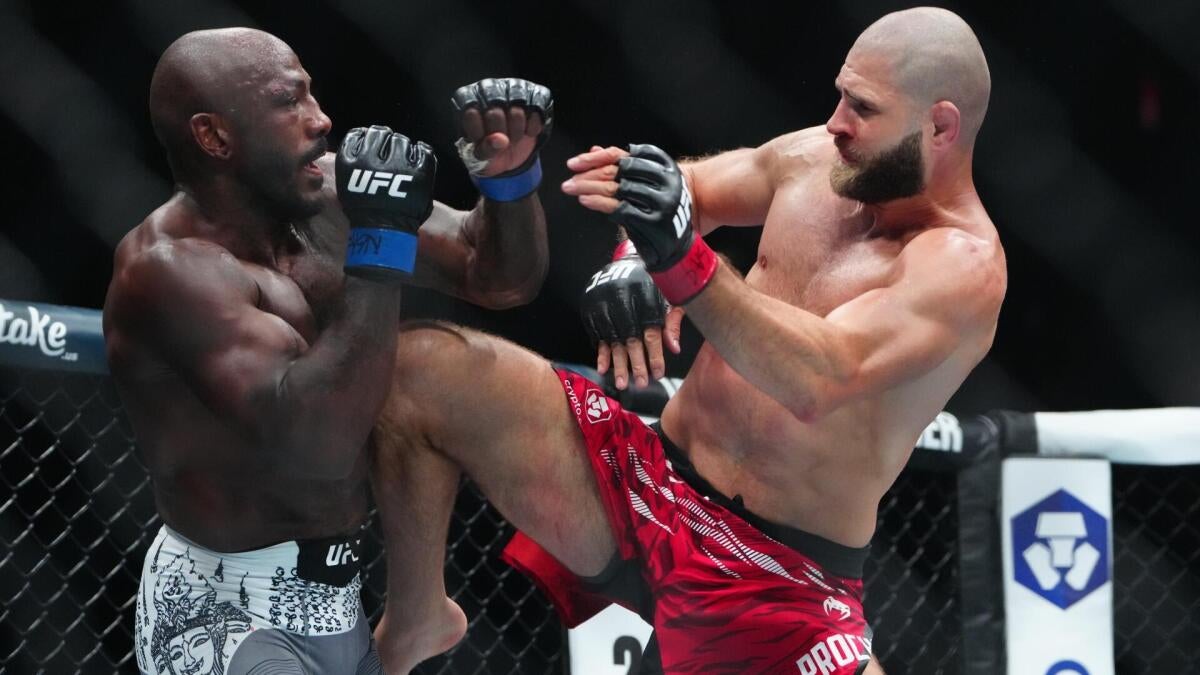
The article highlights Kalshi trading opportunities around UFC 327 on Saturday, with several bouts priced as close matchups, including Prochazka vs. Ulberg at 50 cents per share each and Costa at 31 cents despite a roughly 38% win probability. Other notable prices include Blaydes at 50 cents, Walker at 41 cents, and Landwehr at 49 cents, reflecting a broadly balanced card. The piece is primarily betting and streaming commentary, with limited direct market impact beyond event-driven prediction-market activity.
This is a small but interesting signal on prediction-market microstructure rather than on MMA itself. The edge comes from Kalshi’s habit of clustering prices at round-number levels, which can understate dispersion when the market is anchored to public narratives instead of true win probability. In these cards, the likely mispricing is not in the favorite/underdog direction broadly, but in how much the market pays for volatility: low-liquidity names can overshoot on reputation, while evenly matched bouts can be priced as if uncertainty were symmetric when stylistic variance is actually asymmetric.
The second-order effect is that the biggest expected value may sit in the fighters with the cleanest path-to-victory mismatch, not the highest implied probability. In practice, power-heavy, knockout-oriented profiles create fatter tails than decision-heavy profiles, so “fair” price is often above consensus for underdogs with one-shot upside and below consensus for favorites who need the fight to remain technical for 15 minutes. That tends to matter most in the final 24 hours before the event, when retail flow narrows spreads but also amplifies late narrative momentum.
The contrarian read is that the market may be overvaluing recent streaks and underweighting age/fight-variance. In combat sports, an undefeated record can be a poor proxy for current edge because it often compresses strength-of-schedule and masks fragility; similarly, veteran names can still be mispriced if public memory anchors to peak-era performance. If this card goes the expected route, the cleaner trade is to fade the most crowded favorite at the offer and buy the higher-volatility underdog only where payout asymmetry is meaningfully better than the model-implied line.
AI-powered research, real-time alerts, and portfolio analytics for institutional investors.
Request DemoOverall Sentiment
neutral
Sentiment Score
0.05
