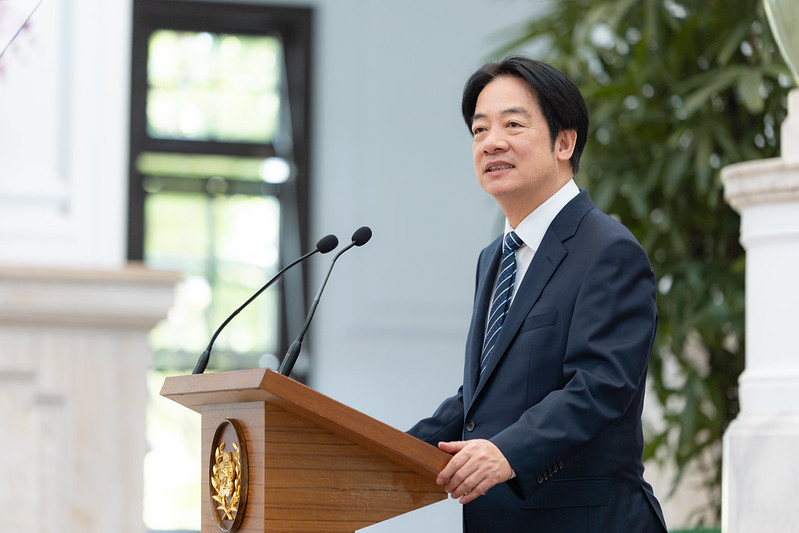
In a recent interview, President Lai Ching-te addressed cross-strait relations, emphasizing that China's aim is to change the international order and that annexing Taiwan is the first step; he stated that a conflict would disrupt global supply chains and cost an estimated $10 trillion, roughly 10% of global GDP. Lai stressed Taiwan's commitment to strengthening national defense and collaborating with the US, Japan, and other democracies to deter China, while also expressing a willingness to engage in exchanges with China based on parity and dignity. Lai also highlighted Taiwan's drone development for national security and industrial needs, seeking collaboration with Japan in this sector.
Taiwan's President Lai Ching-te articulates a multifaceted strategy focused on national security, economic resilience, and international alliances amidst escalating cross-strait tensions. President Lai identified China's intent to alter the rules-based international order, with the annexation of Taiwan as a primary step, a conflict projected to cost the global economy US$10 trillion (approximately 10% of global GDP) and severely disrupt global supply chains, as 20% of global shipping transits the Taiwan Strait. Taiwan's response is anchored by the 'Four Pillars of Peace' action plan: strengthening national defense, bolstering economic resilience, collaborating with democratic nations for deterrence, and maintaining openness to dialogue with China under conditions of parity. A key element of this strategy involves significant development in drone technology for both asymmetric defense capabilities, drawing lessons from the Russo-Ukrainian War, and for industrial applications, with Taiwan actively seeking collaboration with Japan in this sector, mirroring existing semiconductor partnerships. Economically, Taiwan is actively diversifying its trade and investment, reducing its export reliance on China from 43.9% in 2020 to 31.7% in 2024, and shifting outbound investment from 83.8% to China in 2010 to just 7.5% recently, with the US now being the largest recipient at approximately 40%. In response to a 32% US reciprocal tariff, Taiwan plans negotiations aiming for zero-tariff treatment, increased US procurement, expanded US investment, and has allocated NT$93 billion in support for affected domestic industries, alongside a broader NT$410 billion special budget for economic development. President Lai emphasized that Taiwan Semiconductor Manufacturing Company's (TSMC) overseas investments, including in the US, are driven by customer demand and will not dilute Taiwan's R&D focus or strategic importance, which he attributes more to Taiwan's geopolitical position. Furthermore, Taiwan is pursuing deeper economic ties with Japan, including a potential Economic Partnership Agreement (EPA) and support for its CPTPP accession, and is addressing internal security threats by proposing reforms such as the restoration of the military trial system to counter China's infiltration efforts. The government also plans to ensure the defense budget exceeds 3% of GDP.
AI-powered research, real-time alerts, and portfolio analytics for institutional investors.
Request DemoOverall Sentiment
Neutral
Sentiment Score
0.10
Ticker Sentiment
