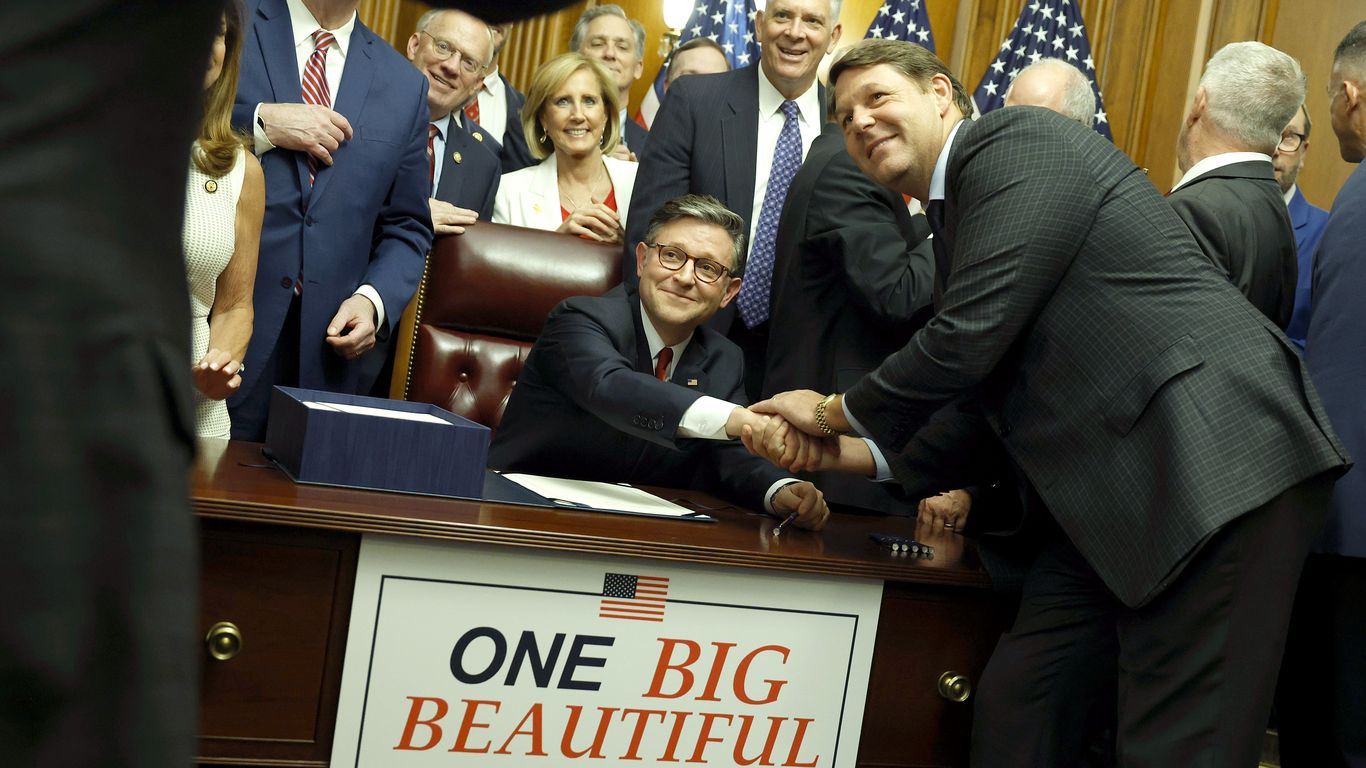
House Budget Chair Jodey Arrington and Senate Budget Chair Lindsey Graham are informally discussing a second reconciliation bill to fund the Pentagon and potentially DHS, with Arrington saying reconciliation may be Republicans' only path. Arrington set a 60–90 day window to complete a package (aiming to wrap before July 4) and wants offsets (fraud/improper-payment savings, tariff revenue, ACA CSR changes). Political obstacles include President Trump's demand to pass the SAVE America Act and disputes over ICE funding, keeping timing and scope uncertain — implications are sectoral (defense/DHS contractors) rather than market-wide unless a deal materializes.
The mechanics being telegraphed favor defense and border-security incumbents while imposing asymmetric political and economic costs on import-exposed sectors. A paid-for supplemental means incremental DoD/DHS outlays would feed into contractor revenue and backlog within a 1–3 quarter window, concentrating upside in firms with rapid contract turnarounds and existing GAO/DFARS pathways for surge funding. Smaller, niche prime and services vendors (detention, IT, logistics) will see a higher percentage impact to EBITDA than large diversified primes, creating dispersion inside the sector.
Offset choices (tariff revenue, ACA CSR adjustments, fraud-recovery accounting) change the transmission to markets: tariffs are a tax on imports that compress retail margins and push input inflation through supply chains over months, while ACA-related offsets bite directly into insurer revenue flows and margins in the same fiscal year. Procedural frictions (Byrd-rule constraints, White House policy demands) make the path binary — either reconciliation passes in a ~60–90 day window or the market faces a protracted policy freeze and elevated shutdown risk, magnifying short-term volatility.
Second-order franchise effects matter: tariffs as offsets raise working capital needs for importers and lift freight/shipping volatility, which can widen credit spreads for levered retail names. Conversely, a narrowly paid-for defense/DHS bill could be modestly yield-accretive relative to baseline deficit expectations, tamping down upward pressure on 10y yields compared with an unfunded supplemental. Monitor Senate scorekeeper signals and initial award pipelines: contract award notices and appropriations execution in the 30–90 day post-passage window will be the first hard evidence of realized winners.
AI-powered research, real-time alerts, and portfolio analytics for institutional investors.
Request DemoOverall Sentiment
neutral
Sentiment Score
0.00
