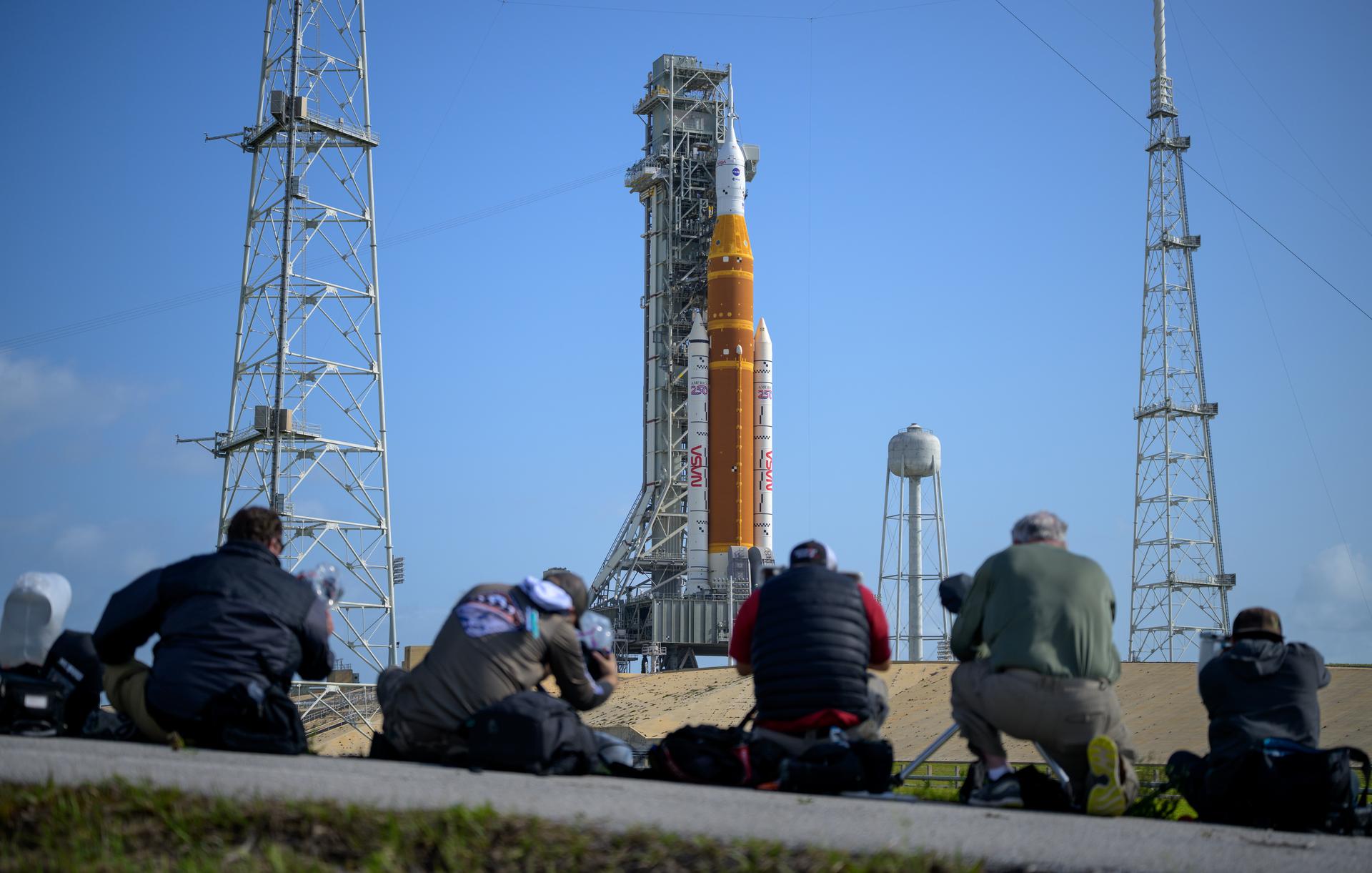
Countdown for NASA's Artemis II is underway with the onsite clock started at 4:44 p.m. EDT targeting liftoff at 6:24 p.m. EDT on April 1; this is the first crewed SLS/Orion mission. Teams are powering up flight hardware and preparing cryogenic tanking to load hundreds of thousands of gallons of liquid hydrogen and liquid oxygen while Pad 39B crews fill the sound suppression water tank; weather forecast shows an 80% chance of favorable conditions, with clouds and high winds as primary concerns. The four-person crew remains in quarantine undergoing medical checks; live tanking coverage begins 7:45 a.m. April 1 on NASA's YouTube channel.
A successful crewed SLS/Orion flight is a program-level validation that de-risks multi-year procurement schedules for prime contractors and ground-integration firms. That validation converts symbolic achievement into contract optionality: expect a clearer line-of-sight for follow-on Artemis hardware, avionics, cryogenic stages and pad sustainment work over the next 3-5 years, which supports steady revenue visibility rather than one-off PR upside.
The most durable second-order winners are firms that own specialized, hard-to-replicate production lines and long lead supply chains — cryogenic tanks, RS-25-class engine support, solid-booster manufacturing and pad modernization — because those capabilities are sticky and have high switching costs. Conversely, pure-play commercial launch providers lose optionality in deep-space, crewed missions even if they remain dominant in LEO; their TAM overlap with heavy-lift crewed missions remains limited absent new NASA procurement decisions.
Immediate tail risks are binary and concentrated: a flight anomaly would likely trigger program reviews, politicize funding and re-open competitive procurement choices, compressing multiples for exposed primes within days and possibly shaving ~10-25% off near-term contractor market caps on information flow alone. The most relevant catalyst cadence is front-loaded — launch outcome (days), follow-up NASA budget/award signals (weeks–months), then contract execution and supply-chain hiring (quarters–years).
The market currently underweights the runway of recurring sustainment work for ground systems and cryogenics while over-emphasizing the PR value of a single flown mission. That mismatch favors tactically buying exposure to operational-capability suppliers on conviction of contract cadence, but only after launch execution risk is cleared or hedged tightly because downside is asymmetric on a bad outcome.
AI-powered research, real-time alerts, and portfolio analytics for institutional investors.
Request DemoOverall Sentiment
neutral
Sentiment Score
0.00
