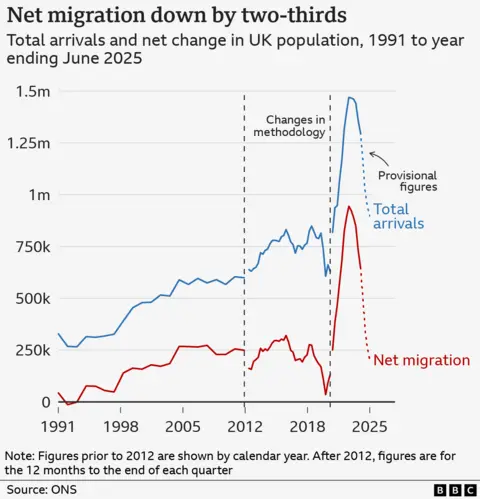
Net migration to the UK fell two-thirds to 204,000 in the year ending June 2025 from 649,000 a year earlier, driven largely by roughly a 70% drop in non‑EU+ arrivals for work and study; the figures cover long‑term moves of 12 months or more. Separately, Home Office data show a record 110,051 asylum claims in the year to September 2025, 45,659 small‑boat arrivals (up 53%), about 36,000 people temporarily housed in hotels and 133,502 initial asylum decisions (45% granted) with a 36% fall in cases awaiting initial decision — developments that tighten labour supply, sustain pressure on local housing/ services and keep migration policy and legal disputes salient for political and fiscal planning.
Market structure: Lower net migration driven by -~70% fall in non-EU+ work and study arrivals tightens UK labour supply in certain sectors (hospitality, care, construction, universities) while reducing demand for student housing and local services. winners: domestic temp/recruitment agencies and employers with pricing power who can pass on higher wages; losers: housebuilders, residential REITs, student accommodation landlords and education services that rely on international students. Cross-asset: expect modest downward pressure on UK GDP growth vs. peers (negative for cyclicals), potential sterling softening, and mixed gilt reaction (growth scare lowers yields, asylum fiscal costs push some fiscal premium higher).
Risk assessment: Near term (days-weeks) political headlines and Home Office operational moves (hotel closures, military bases) will drive volatility; short-term (1–3 months) migration releases and university enrolment cycles will determine revenue hits; medium-term (3–12 months) wage inflation and labour substitution will materialise. Tail risks include a sharp policy U-turn (mass removals or open enrolment) or legal rulings forcing increased asylum housing costs—either could swing fiscal and local-property outcomes by >5–10% for affected sectors. Hidden dependency: local rental markets in university towns are disproportionately sensitive to international student flows; a 30–50% fall in student arrivals can cut occupancy rates by double digits within a semester.
Trade implications: Short UK residential real estate exposure (housebuilders BDEV.L, TW.L, PSN.L and landlords UTG.L, GRI.L) where demand is directly tied to population/work-study inflows; go long recruitment/contract staffing (HAS.L) and selected healthcare staffing names to benefit from wage-driven temp demand. Use options to size asymmetric risk: buy puts on a housebuilder basket for 3–6 months; sell short-dated covered calls on Hays to finance carry. Rotate away from UK domestic cyclical small-caps into global defensives and rate-sensitive assets if next two ONS prints stay >50% below prior year.
Contrarian angles: Consensus frames this as uniformly negative for UK demand — but tighter labour supply can create structural pricing power for firms in low-skill-intensive sectors, supporting margins and recruitment fees (contrarian long Hays/HAYS). The market may be overpricing permanent demand loss for housing: if policy drives temporary asylum hotel use down but small-boat arrivals remain high, local housing demand could re-concentrate and snap back within 6–12 months. Historical parallel: 2016–18 migration shocks saw 6–9 month headline weakness in housebuilder earnings before mean reversion; watch 2 sequential ONS prints before committing large directional bets.
AI-powered research, real-time alerts, and portfolio analytics for institutional investors.
Request DemoOverall Sentiment
neutral
Sentiment Score
0.00
