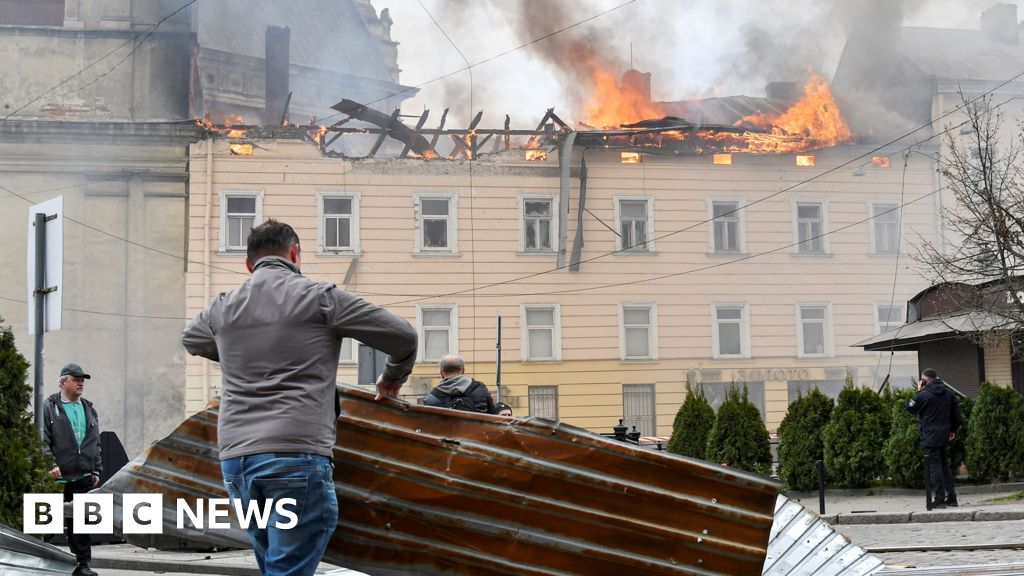
Russia launched 948 drones in a 24-hour period — the largest aerial attack since the war began — causing at least eight deaths and dozens injured (22 injured in Lviv; two killed and four injured in Ivano-Frankivsk; one killed and 11 injured in Vinnytsia), and damaging civilian and cultural infrastructure including a 16th-century Unesco site and a maternity hospital. Expect near-term risk-off market moves in Europe, upward pressure on defense names and potential energy price volatility, with sustained geopolitical risk driving safe-haven flows and sectoral rebalancing.
The tactical shift toward high-volume, distributed aerial saturation favors companies that supply layered air-defence (radar, C2, interceptors) and the electronic-warfare (EW) kits that enable shoot-look-shoot cycles. Primes with existing production capacity and modular sensor-to-shooter integration will convert orders fastest; incremental programs of a few billion dollars typically lift a prime’s booked backlog by low-single-digit percentage points and can translate into 5–15% EPS upside over 6–18 months if production bottlenecks are cleared.
A material second‑order effect is supply-chain stress on RF/MEMS/actuator suppliers and on small-arms-to-platform integrators: expect multi-quarter lead times for RF front-ends, guidance MEMS, and propulsion components which will bid up ASPs and margins for specialized suppliers. Insurance and reinsurance pricing is likely to reprice regionally, raising premiums for air- and infrastructure-exposed portfolios and pressuring commercial property valuations in adjacent markets.
The main catalysts are policy (NATO/EU approvals and funding windows) and industrial ramp capacity: a coordinated supply push can blunt the kinetic advantage within 60–120 days, while constrained component supply can extend the pressure into quarters. A diplomatic de-escalation or weather-limited campaign could reverse market flows quickly; conversely, sustained saturation tactics would entrench defense capex increases over multiple budget cycles.
For positioning, prefer exposure to modular systems and RF supply chains with 6–18 month convexity to orders; underweight near-term travel/leisure exposures tied to regional demand and selectively hedge credit or insurance lines that are exposed to concentrated losses.
AI-powered research, real-time alerts, and portfolio analytics for institutional investors.
Request DemoOverall Sentiment
strongly negative
Sentiment Score
-0.85
