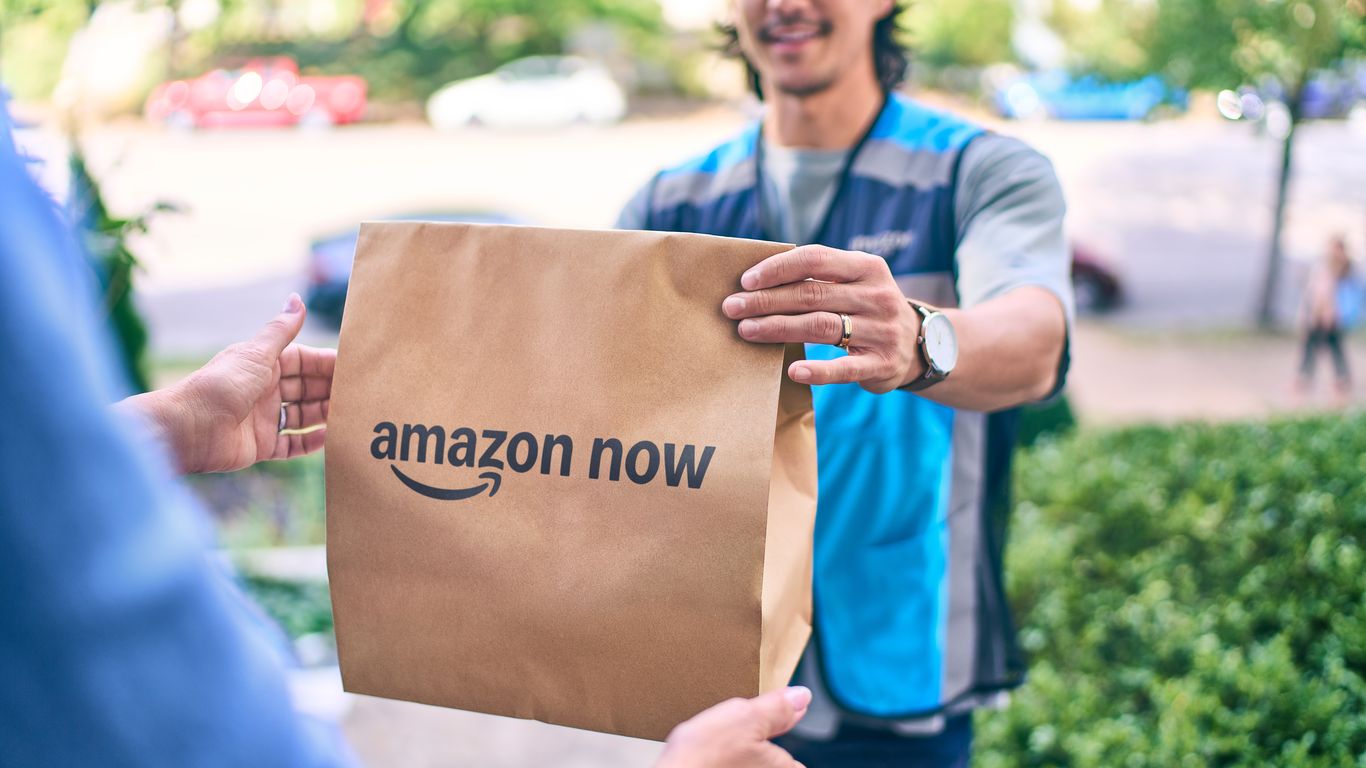
Amazon is expanding Amazon Now, a 30-minute delivery service, across dozens of U.S. cities, with wide availability already in Atlanta, Dallas-Fort Worth, Philadelphia and Seattle and rollout underway in several others. Prime members pay $3.99 per order versus $13.99 for non-members, signaling a monetized push into ultra-fast retail fulfillment. The move intensifies the speed competition with Walmart, Target and delivery apps, but it is mainly a strategic retail/logistics update rather than a near-term market catalyst.
AMZN is using speed as a retention lever, not just a logistics feature. The economic value is that a 30-minute option raises purchase frequency on low-basket, high-urgency items and keeps Prime embedded in daily habit formation, which should improve ad load, basket attach, and checkout capture over time even if the service itself is low-margin. The real strategic win is not shipping revenue; it is shifting consumer default behavior away from “plan and compare” toward “buy now,” which is structurally favorable for the largest first-party marketplace with the deepest fulfillment network.
The second-order loser set is broader than the obvious retail peers. WMT and TGT face a margin squeeze if they respond with their own speed initiatives because same-hour fulfillment is operationally expensive and tends to cannibalize higher-margin planned trips; the burden falls first on labor density, micro-fulfillment capex, and last-mile incentives. DASH is more exposed on the selection side than the delivery side: if Amazon can cover urgent household replenishment in a single interface, it reduces the frequency of casual convenience orders where delivery apps take the highest take rate and strongest wallet share.
The key risk is that ultra-fast delivery is still a niche economics game outside dense corridors. If Amazon overbuilds capacity before demand proves sticky, the P&L drag will show up over the next 2-4 quarters as underutilized inventory nodes and elevated labor cost per order, especially in lower-density markets. A countervailing catalyst would be if Prime conversion or reorder frequency inflects in the launched cities; that would validate the thesis that speed can be monetized via lifetime value, not just delivery fees.
Consensus is likely underestimating how much this intensifies antitrust and local-regulatory scrutiny. Once retailers fuse marketplace, logistics, and subscription into a single “instant commerce” stack, regulators may focus less on pricing and more on exclusionary ecosystem power and labor classification, which could cap how aggressively the model scales internationally. Near term, the market may treat this as incremental; over 6-12 months, the bigger question is whether this becomes a durable demand acquisition engine or a costly race to the bottom in fulfillment economics.
AI-powered research, real-time alerts, and portfolio analytics for institutional investors.
Request DemoOverall Sentiment
mildly positive
Sentiment Score
0.20
Ticker Sentiment
