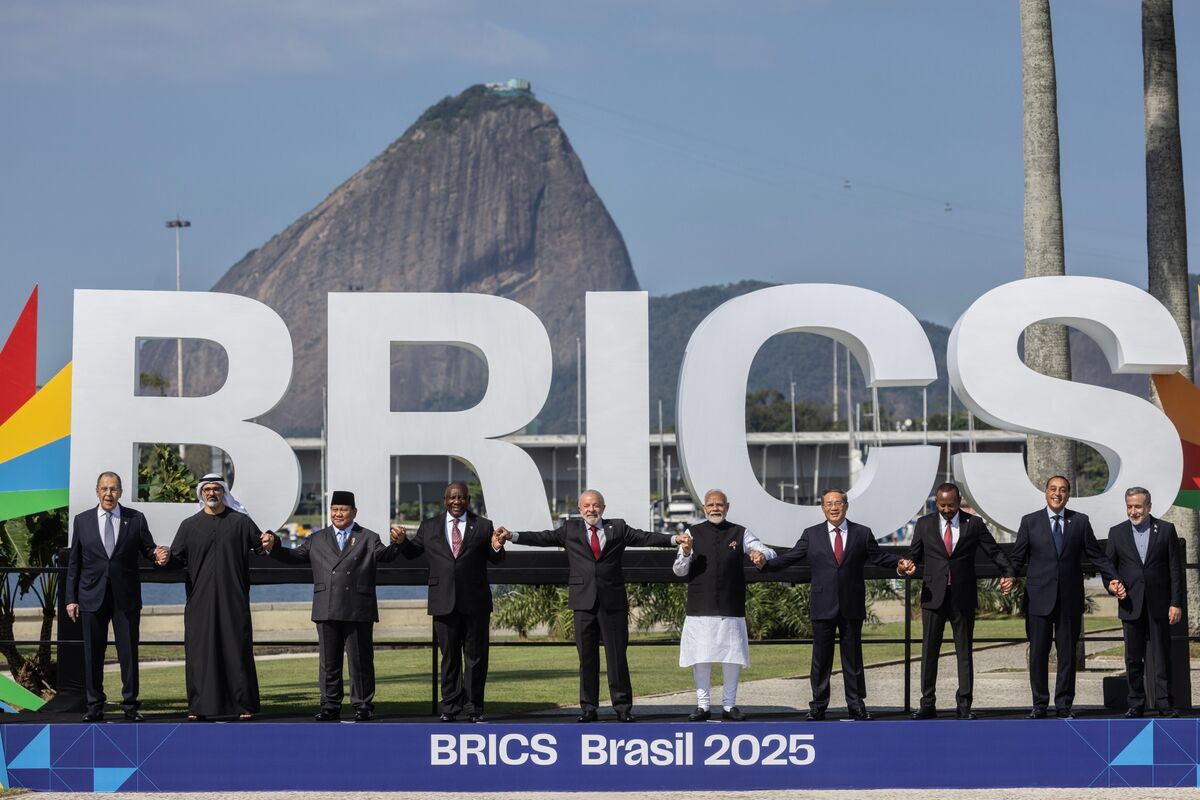
The BRICS summit convened in Rio de Janeiro, with Brazilian President Lula da Silva, alongside India's Narendra Modi and South Africa's Cyril Ramaphosa, taking center stage. Chinese President Xi Jinping was notably absent, while foreign ministers from Russia and Iran attended as part of the newly-expanded bloc. This gathering underscores the evolving internal dynamics and geopolitical leanings of the expanded emerging-market bloc.
The BRICS summit in Rio de Janeiro highlights a significant shift in the bloc's internal dynamics, underscored by the conspicuous absence of China's President Xi Jinping. While Brazil's Luiz Inacio Lula da Silva, India's Narendra Modi, and South Africa's Cyril Ramaphosa are positioned centrally, signaling their key roles, China's absence raises questions about its current level of engagement and influence within the newly-expanded group. The inclusion of foreign ministers from Russia and Iran, positioned on the flanks, confirms the bloc's geopolitical orientation but also suggests a potential hierarchy or tiered status among members. This configuration points towards an evolving power structure where nations like Brazil and India may be assuming more prominent leadership roles, at least symbolically. The event's neutral sentiment and low market impact score indicate that while the developments are noteworthy for long-term strategic analysis, they have not yet translated into immediate market-moving events.
AI-powered research, real-time alerts, and portfolio analytics for institutional investors.
Request DemoOverall Sentiment
neutral
Sentiment Score
0.00
