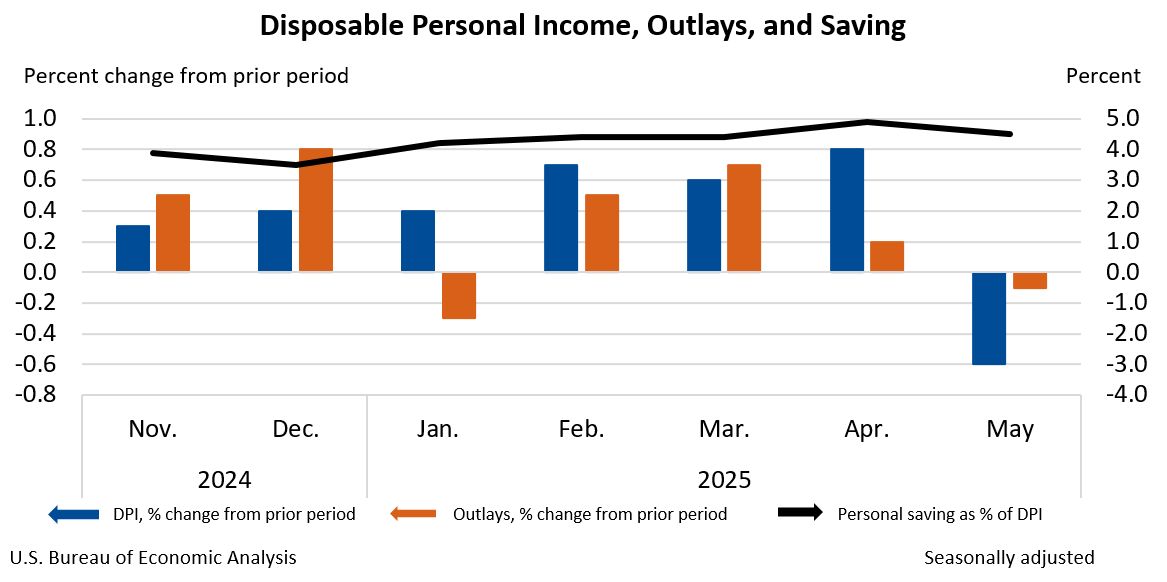
U.S. personal income declined 0.4% in May, with disposable personal income (DPI) dropping 0.6% and personal consumption expenditures (PCE) decreasing 0.1%. The income reduction primarily stemmed from lower government social benefits and farm proprietors' income, partially offset by rising compensation. Concurrently, the PCE price index increased a modest 0.1% monthly (0.2% core), yet remained elevated year-over-year at 2.3% (2.7% core), indicating persistent inflationary pressures despite a notable slowdown in consumer spending.
The May 2025 economic data indicates a notable deceleration in the U.S. consumer engine, driven by a confluence of factors. Personal income contracted by 0.4%, with real disposable personal income falling a more significant 0.7%, suggesting a real-terms erosion of consumer purchasing power. This income decline was primarily attributed to a decrease in government social benefits and farm proprietors' income, masking underlying resilience in the labor market where private wages and salaries continued to increase. Concurrently, personal consumption expenditures (PCE) fell by 0.1% (0.3% in real terms), with a clear divergence between a $49.2 billion decrease in spending on goods and a $19.9 billion increase in services spending. This dynamic, coupled with a rise in the personal saving rate to 4.5%, points to a more cautious consumer who is pulling back on discretionary goods purchases. On the inflation front, the data is mixed; while the month-over-month PCE price index rose a modest 0.1% (0.2% for core), the year-over-year core PCE remains elevated at 2.7%, indicating that while inflationary pressures are cooling, they have not been fully extinguished.
AI-powered research, real-time alerts, and portfolio analytics for institutional investors.
Request DemoOverall Sentiment
mixed
Sentiment Score
-0.15
