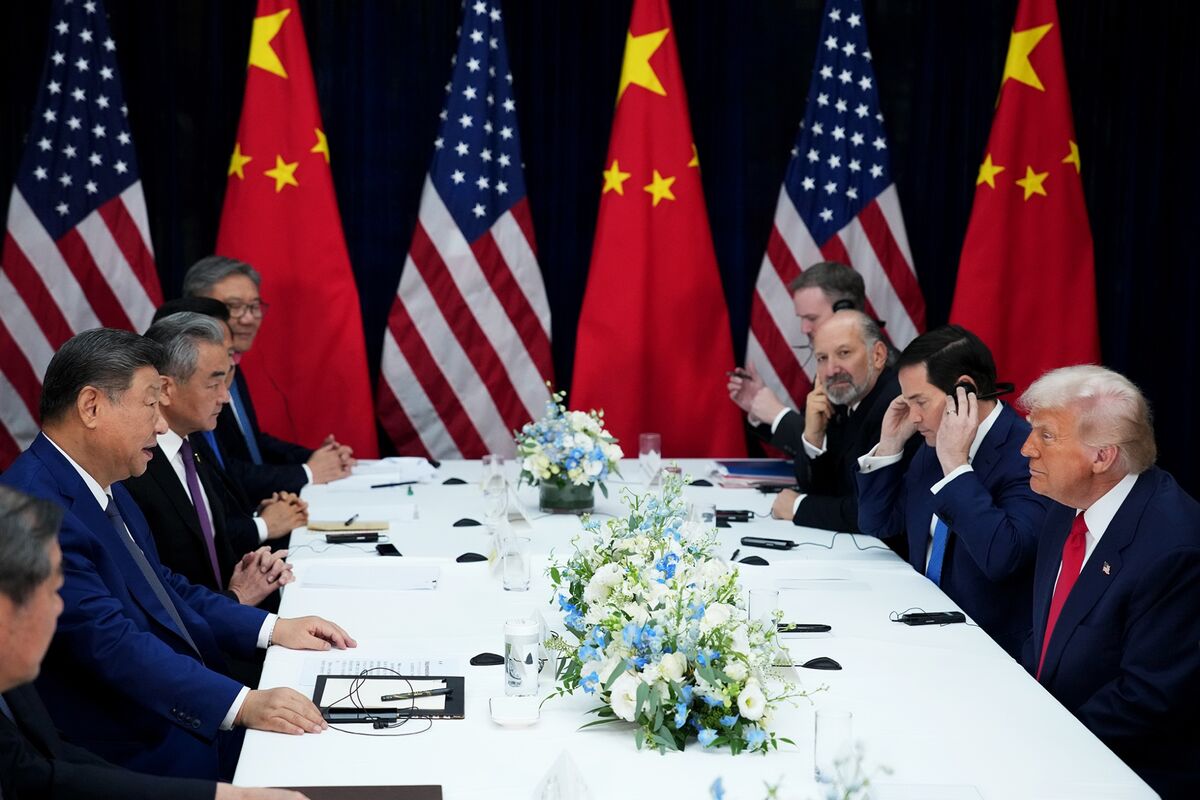
Treasury Secretary Scott Bessent said there could be as many as four meetings between President Trump and Chinese leader Xi Jinping next year as both sides seek to preserve a fragile trade truce. His remarks underscore a constructive bilateral leadership relationship that could reduce near-term trade-policy tail risks, though he emphasized rivalry remains and cooperation is selective, suggesting limited but positive implications for risk assets sensitive to U.S.-China policy uncertainty.
Market structure: A credible prospect of up to four Trump–Xi meetings next year reduces the geopolitical risk premium for China-facing cyclicals and semiconductors. Direct winners: large-cap semiconductors (NVDA, TSM, SMH/SOXX), industrial exporters (CAT), and copper/miners (FCX) from supply‑chain normalization; losers include defense primes (LMT, RTX) and pure-play onshoring beneficiaries that priced in permanent decoupling. Cross-asset: expect modest USD softness vs CNY, upward pressure on industrial commodities (copper +3–8% over 3–9 months plausible), and a rotation out of long-duration Treasuries (yields +10–30bp on successful détente news).
Risk assessment: Tail risks include rapid re‑escalation (tariffs or tech controls) and surprise domestic political shocks around US/China elections; these would reverse rallies within days. Immediate (days): news-driven spikes in China/semis; short-term (weeks–months): positioning build and commodity reflation; long-term (quarters+): structural tech decoupling persists despite meetings. Hidden dependencies: corporate capex decisions hinge on concrete market‑access steps, not just leader meetings. Catalysts: joint statements, tariff removal, or new export control lists; failure to produce deliverables will stall rallies.
trade implications: Tactical overweight semis and China large-caps for a 3–9 month window; implement asymmetric options to cap downside. Pair trades: long SMH/SOXX vs short LMT/RTX to express trade détente > defense drawdown. Bond/fx: shorten duration and favor CNY strength plays; allocate commodity exposure to copper via FCX or COPX.
contrarian angles: Consensus treats leader meetings as binary positives; markets may underprice the limited scope (e.g., keeping tariffs but easing services rules). If meetings are frequent but deliverables low, expect mean reversion and a selling-of-the-news snapback of 8–15%. Historical parallel: 2018–19 détente phases produced 6–12% cyclicals rallies that faded without binding agreements. Unintended consequence: a stronger CNY could spark local financial tightening, pressuring China equities despite trade improvement.
AI-powered research, real-time alerts, and portfolio analytics for institutional investors.
Request DemoOverall Sentiment
mildly positive
Sentiment Score
0.25
