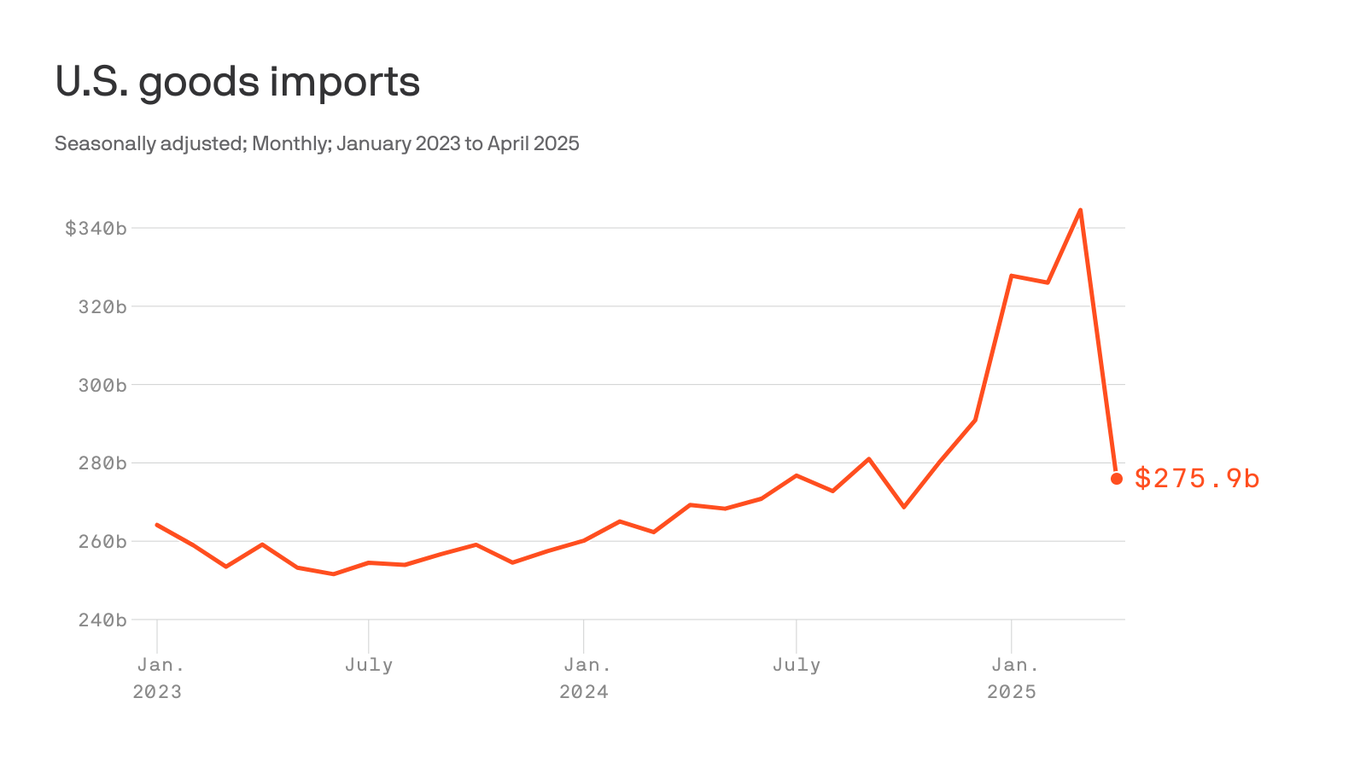
U.S. goods imports experienced a record monthly drop in April, driven by the impact of President Trump's tariff policies, reversing the prior month's front-loading effect as companies rushed to import goods ahead of tariff implementation. Trade with China fell to its lowest level since March 2020, with imports from China at $25.4 billion and U.S. exports to China declining to $8.2 billion. According to High Frequency Economics, the import decline reflects the impact of tariffs rather than a weakening economy, as companies are drawing down elevated inventories built up in anticipation of the tariffs.
U.S. goods imports experienced a record monthly decline in April, a direct consequence of the Trump administration's tariff policies, reversing the preceding month's front-loading activity as businesses rushed to import goods before tariffs were enacted. This sharp contraction is evidenced by Commerce Department data, though imports remained up year-over-year. Notably, trade with China reached its lowest level since the pandemic-induced global economic shutdown in March 2020, with April imports from China falling to $25.4 billion and U.S. exports to China decreasing to $8.2 billion. According to Carl Weinberg, chief economist at High Frequency Economics, this downturn is primarily a reflection of triple-digit tariff rates impacting trade flows and companies drawing down previously stockpiled inventories, rather than an indicator of a weakening U.S. economy. The overall sentiment surrounding this data is moderately negative, with a cautious tone reflecting the ongoing trade policy uncertainties.
AI-powered research, real-time alerts, and portfolio analytics for institutional investors.
Request DemoOverall Sentiment
moderately negative
Sentiment Score
-0.50
