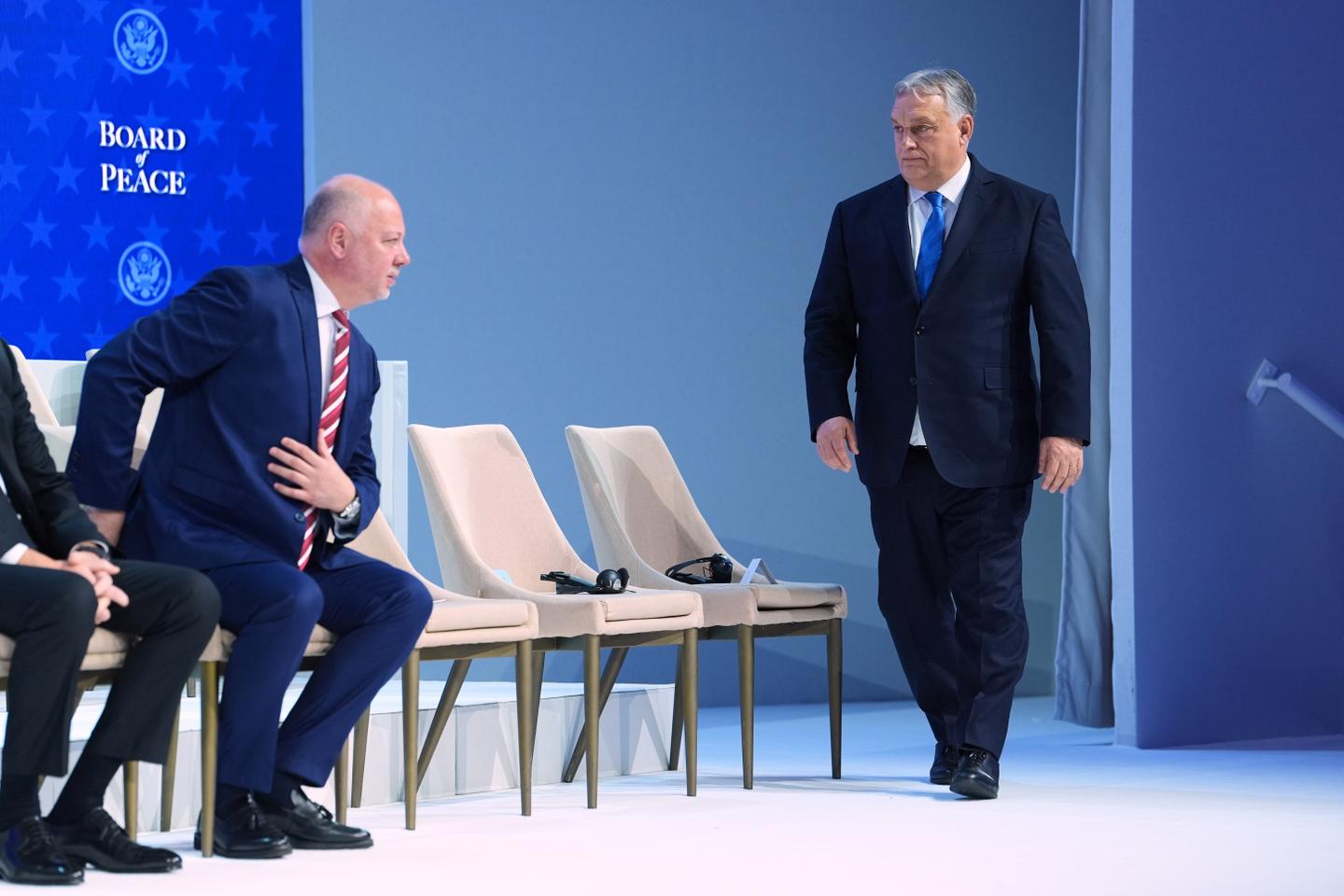
Donald Trump’s newly created 'Board of Peace' will hold its inaugural meeting in Washington on February 19, convened to discuss the future of Gaza but described by organizers as seeking to supplant the United Nations. Several major European capitals — London, Paris, Madrid and Berlin — have refused to participate, while at least two European countries and a number of others plus the European Commission will attend as observers; Hungarian Prime Minister Viktor Orban has publicly declared he will join. The development is primarily political and may increase diplomatic friction and geopolitical risk perceptions, but it is unlikely to have immediate, direct market-moving implications.
Market structure: A US-led “Board of Peace” that sidelines the UN would asymmetrically favor US defense primes (LMT, RTX, GD) and US construction/heavy-equipment suppliers (CAT, VMC) for reconstruction contracts while pressuring European multinationals (EADSY, CRH) who lose political access. Commodities tied to rebuilding — steel, copper, cement — could see incremental demand of ~5–15% over 12–24 months in a large reconstruction scenario, supporting miners like FCX and steel names like NUE. FX/flow impact will likely be USD-positive (safe-haven + policy alignment) and EUR-negative if EU cohesion visibly cracks; sovereign bond spreads of smaller pro-US EU states could widen vs. core Germany by 20–80bp if political fragmentation accelerates.
Risk assessment: Immediate (days) risk is headline-driven FX and VIX spikes; short-term (weeks–months) risks include procurement signaling and US/EU political reprisals that re-price defense and construction equities; long-term (quarters–years) risk is institutional fragmentation raising structural geopolitical risk premia. Tail scenarios: military escalation that lifts Brent >$100/barrel within 30 days or coordinated EU sanctions fracturing trade, each low-probability but >5% market-impact events. Hidden dependencies: US appropriations schedule (next 60–120 days) and EU internal votes — both are binary catalysts that would materially change exposures.
Trade implications: Favor directional exposure to US defense and materials via concentrated, time-limited positions: buy 6–9 month call spreads on LMT and RTX to capture procurement upside while capping premium; size 1–3% notional each. Hedge geopolitical shorts in EUR via a 0.5–1% EURUSD short using forwards or FX options; buy GLD (1–2% portfolio) as a volatility hedge if Brent >$90. Avoid large-cap European industrials until EU unity is re-assessed post next 60 days; consider pair trades long CAT vs short CRH for relative reconstruction optionality.
AI-powered research, real-time alerts, and portfolio analytics for institutional investors.
Request DemoOverall Sentiment
neutral
Sentiment Score
0.00
Contrarian angles: Consensus may overstate immediate policy impact — the board is largely symbolic over 0–90 days, so headline spikes in oil/defense could mean-revert; selling short-dated oil call overlays if Brent rallies >10% from current levels is a viable contrarian trade. Conversely, if US appropriation bills explicitly fund reconstruction within 90–180 days, market underprices multi-year revenue streams for US suppliers — a mispricing to exploit with 9–18 month LEAPS on LMT/CAT. Unintended consequence: politicized contracting raises litigation/regulatory risk that can compress multiples; cap positions to defined-loss option structures.
