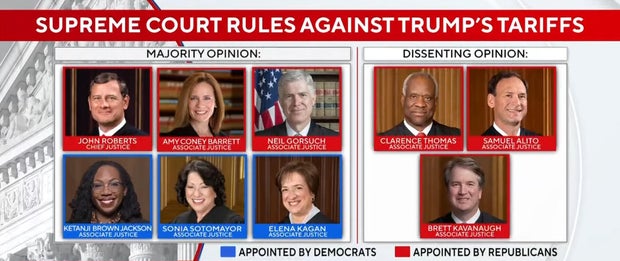
The Supreme Court, in a 6-3 decision authored by Chief Justice Roberts, held that the International Emergency Economic Powers Act (IEEPA) does not authorize the president to unilaterally impose broad tariffs, upholding the Federal Circuit and invalidating President Trump's global tariff program. The ruling raises questions about potential refunds sought by importers and major retailers (Costco, Crocs, Revlon) and could materially affect Treasury receipts — the U.S. collected $195 billion in tariff revenue in FY2025 and $28 billion in January — while leaving open the administration's ability to pursue tariffs under other statutory authorities.
Market structure: The Supreme Court decision removes a broad, administratively-imposed ~10–13% effective tariff layer that skewed pricing and rents to domestic producers; immediate beneficiaries are large import-heavy retailers (COST, CROX) and consumer-goods manufacturers who should see a 5–12% margin recovery over 3–6 months as input tariffs unwind. Domestic steel/aluminium producers (NUE, STLD) and niche ‘reshoring’ contractors lose pricing power and face margin compression of ~5–15% if alternative protection isn’t enacted.
Risk assessment: Tail risks include (A) rapid reimposition of similar levies under other statutes within 30–90 days, (B) protracted refund litigation creating Treasury cashflow shock (>$20–50bn risk of near-term liabilities), and (C) trade-retaliation volatility. Near-term (days–weeks) expect elevated equity and FX volatility; medium-term (3–6 months) legal settlements and refund windows will drive earnings revisions; long-term (1–3 years) congressional action or new tariffs could reprice cyclicals.
Trade implications: Tactical long bias to import beneficiaries (COST, CROX) and short/underweight in domestic basic materials (NUE, STLD); favor consumer staples/discretionary over industrials for next 3–6 months. Use options to capture asymmetric moves: buy 3-month CALLs on COST (small size) and buy puts on NUE to hedge policy re-labelling risk.
Contrarian angles: Consensus expects a clean pass-through to consumers — but inventory timing and supply contracts mean companies that prepaid tariffs will seek refunds not instant price reductions; some importers already hedged costs into 2026. Watch for Congress to monetize lost tariff revenue via targeted subsidies/taxes which could offset beneficiaries; if >$30bn refunds are awarded within 120 days, expect USD weakness and commodity downside.
AI-powered research, real-time alerts, and portfolio analytics for institutional investors.
Request DemoOverall Sentiment
neutral
Sentiment Score
0.05
Ticker Sentiment
