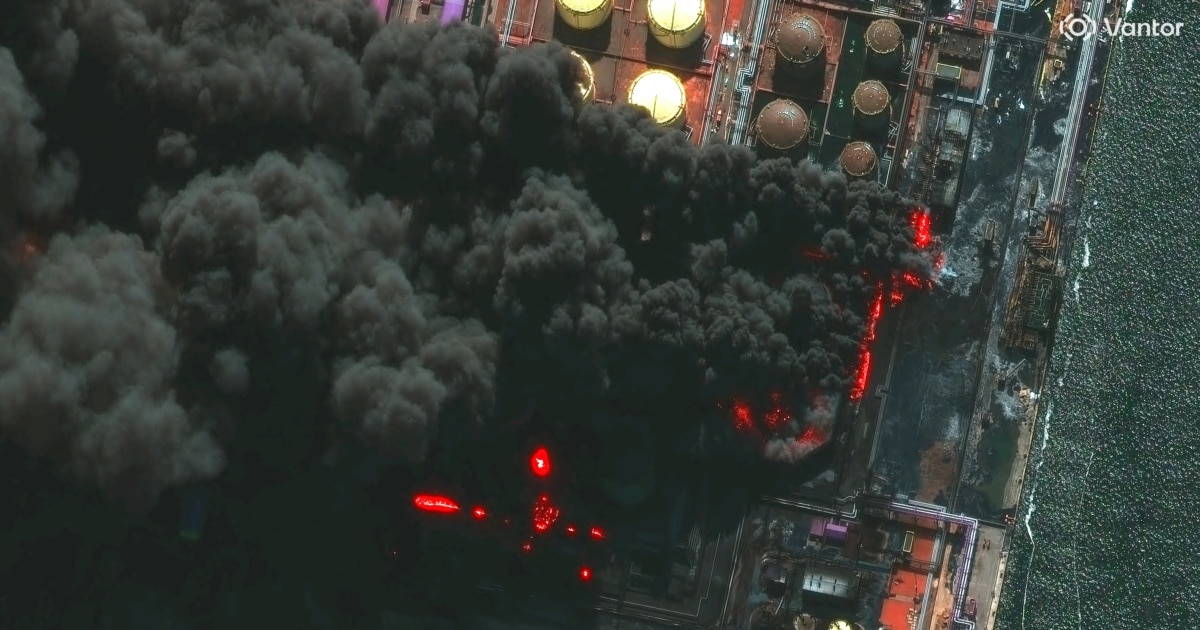
Ust-Luga oil export terminal was struck by Ukrainian drones on March 29 (third hit in a week), with regional officials and President Zelensky saying roughly 60% of Ust-Luga’s export capacity was knocked out; Reuters has reported the wider Ukrainian campaign may have taken >40% of Russia’s overall export capacity offline. The attacks (including hits to Primorsk and an offline Druzhba pipeline) materially constrain Russian oil flows to Western markets, posing upward pressure on global oil prices, disrupting shipping/logistics and increasing operational and insurance risks for energy trade; reposition energy exposures and monitor freight, insurance and regional escalation risks.
The market is moving from a pure production shock narrative to a logistics/shipping and quality-arbitrage shock that amplifies price moves without requiring sustained output cuts. When chokepoints or port access become unreliable, marginal barrels incur added freight, insurance and transload costs that effectively remove cheaper supply from the Atlantic basin arbitrage — the immediate result is a disproportionate widening of European middle distillate cracks versus headline Brent. That dynamic favors assets that control physical distribution (tankers, storage) and refiners that can pivot to heavy-sour feedstock or have export economics, while pressuring refiners dependent on short-haul feedstock flows.
Second-order beneficiaries include owners of midstream export capacity and short-duration tonnage; their revenue is convex because charter rates spike as utilization approaches bottleneck. Defense suppliers focused on counter-UAS, ISR and coastal radar will see durable demand increases — procurement cycles of 12–36 months create multi-quarter revenue visibility. Conversely, entities most exposed are insurers, commodity trading desks with concentrated carry positions, and downstream consumers in Europe who face higher delivered costs and narrower refining margins unless they substitute feedstocks or increase blending costs.
Key tail risks: rapid escalation that targets international shipping lanes or prompts third-party interdiction would materially reprice both risk premia and freight (days–weeks). Near-term reversals could come from a diplomatic freeze, rapid deployment of effective coastal air defenses, or coordinated SPR releases — each could cut the implied oil volatility and compress tanker rates within 30–90 days. Position sizing should assume high gamma: big moves are possible quickly, but policy or defense responses can remove the premium just as fast.
AI-powered research, real-time alerts, and portfolio analytics for institutional investors.
Request DemoOverall Sentiment
strongly negative
Sentiment Score
-0.60
