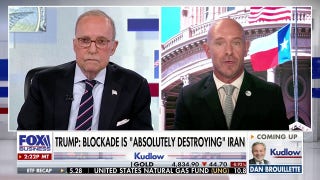
The article calls for an intensified financial squeeze on Iran through port blockades, asset seizures, secondary sanctions, and exclusion from Swift and New York Fed wire channels. It claims Iran is losing more than $400 million per day and argues the IRGC could soon struggle to make payroll, underscoring severe pressure on Iranian banking and foreign-held deposits. The piece is highly geopolitical and could affect sanctions-sensitive EM banking, trade, and FX exposures, though it is opinion-driven rather than a policy announcement.
The market implication is not the headline rhetoric but the attempted conversion of a sanctions regime into a true balance-sheet crisis. If enforcement tightens across shipping, correspondent banking, and offshore custody, the first-order hit is not just Iranian hard-currency inflows; it is working-capital disruption for any intermediary that touched the flow, especially regional banks and trade-finance conduits that rely on thin compliance margins. That creates a nonlinear effect: once payment certainty falls below a threshold, even non-sanctioned counterparties widen haircuts or pull lines, so the damage compounds faster than the nominal trade loss. The second-order beneficiaries are not only obvious U.S. energy producers; they are non-U.S. producers and logistics links that can replace marginal supply without direct exposure to Middle East shipping risk. UAE, Qatar, Turkey, and Turkish/Emirati trade-finance hubs could see a short-term rise in fee income from rerouted commerce, but they also face the larger risk of secondary-sanctions leakage, which would pressure bank valuations and dollar funding costs. In FX, the clean read is stronger support for hard-currency exporters and a modest tailwind to the dollar versus EMs with external funding needs, while regional EM credit spreads should cheapen first if enforcement is credible. The key risk is that this becomes a bargaining tool rather than a durable policy shift. Markets should price the fastest adjustment over days to weeks in shipping, bank compliance, and CDS; the larger macro effect on oil balances and EM capital flows would take 1-3 months. If enforcement softens, or if exemptions/proxy routes proliferate, the squeeze turns into headline noise and the most crowded geopolitical premium trades would unwind quickly. Contrarian view: the consensus may be overestimating how quickly financial isolation forces regime change and underestimating adaptation. A networked sanctions target usually responds by increasing opacity, using gold, crypto, barter, and third-country trade finance rather than stopping flow entirely; that means the trade is less about total shutdown and more about forced inefficiency, higher transaction costs, and lower realized proceeds. That argues for trading the volatility spike, not assuming a straight-line collapse in Iranian revenue.
AI-powered research, real-time alerts, and portfolio analytics for institutional investors.
Request DemoOverall Sentiment
strongly negative
Sentiment Score
-0.55
