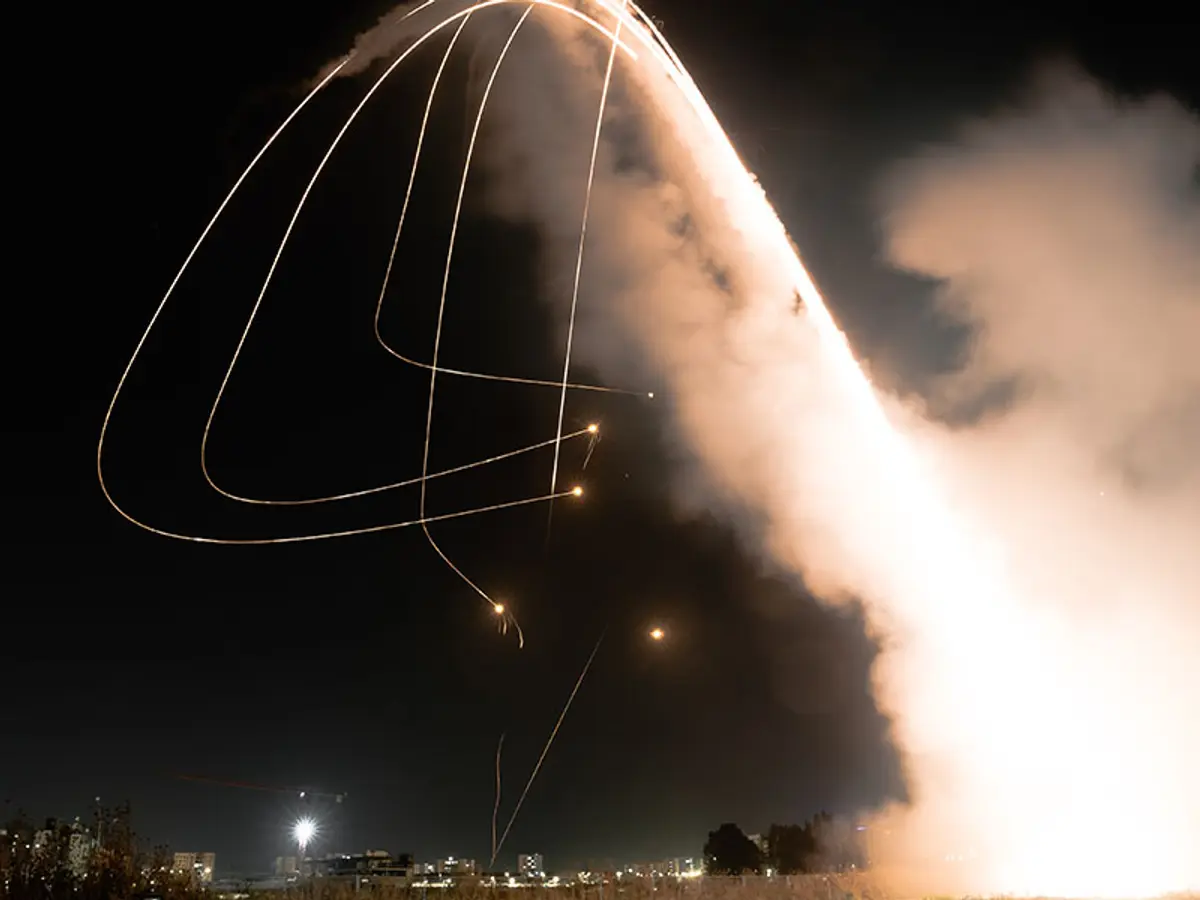
Rafael's Iron Beam is a 100-kilowatt laser air-defence system that concentrates energy into a coin-sized (≈25 mm) spot to engage targets smaller than a football, using medium-wave infrared thermal imaging, high-frame-rate near-IR sensors, dual-channel coarse/fine tracking, metre-accurate laser rangefinders, adaptive optics (deformable mirrors adjusting ~1,000 times/sec) and embedded AI to scan thousands of times per second and maintain lock even in smoke, dust or turbulence; test data shows over 90% interception rates and an estimated cost per engagement of about $3, making it an economically viable counter to cheap drones that traditional missile systems cannot cost-effectively address. Rafael unveiled an upgraded Iron Beam 450 in June 2025 with improved laser directors, extended engagement range and faster cycles, and final trials reportedly included interceptions of rockets, mortars and UAVs, signalling a step-change in low-cost, precision directed-energy air defence for proliferating small-attack threats.
Rafael's Iron Beam is described as a 100-kilowatt directed-energy air-defence system that concentrates its laser onto a coin-sized spot (~25 mm) to engage targets smaller than a football, using medium-wave infrared thermal imaging, high-frame-rate near‑IR fine trackers and metre-level laser rangefinders. The system pairs adaptive optics (deformable mirrors adjusting ~1,000 times/sec) with embedded AI and dual-channel coarse/fine tracking to scan thousands of times per second and maintain lock in smoke, dust and turbulence.
Reported test data claim over 90% interception rates and an estimated cost per engagement of roughly $3, making countering inexpensive UAVs economically viable compared with missile interceptors; the June 2025 Iron Beam 450 upgrade is said to extend range and intercept rockets, mortars and UAVs in final development trials. Thermal-signature classification and neural-network prediction of evasive maneuvers are highlighted as means to reduce false positives and sustain engagements against small fast-moving low-altitude threats.
The strategic implication is a potential shift in counter-UAS economics and procurement priorities if operational performance and integration hold, but the article leaves open key commercial and operational questions: long-term reliability in diverse environments, system acquisition and installation costs, production scale and regulatory/export constraints that will determine real market impact.
AI-powered research, real-time alerts, and portfolio analytics for institutional investors.
Request DemoOverall Sentiment
moderately positive
Sentiment Score
0.55
