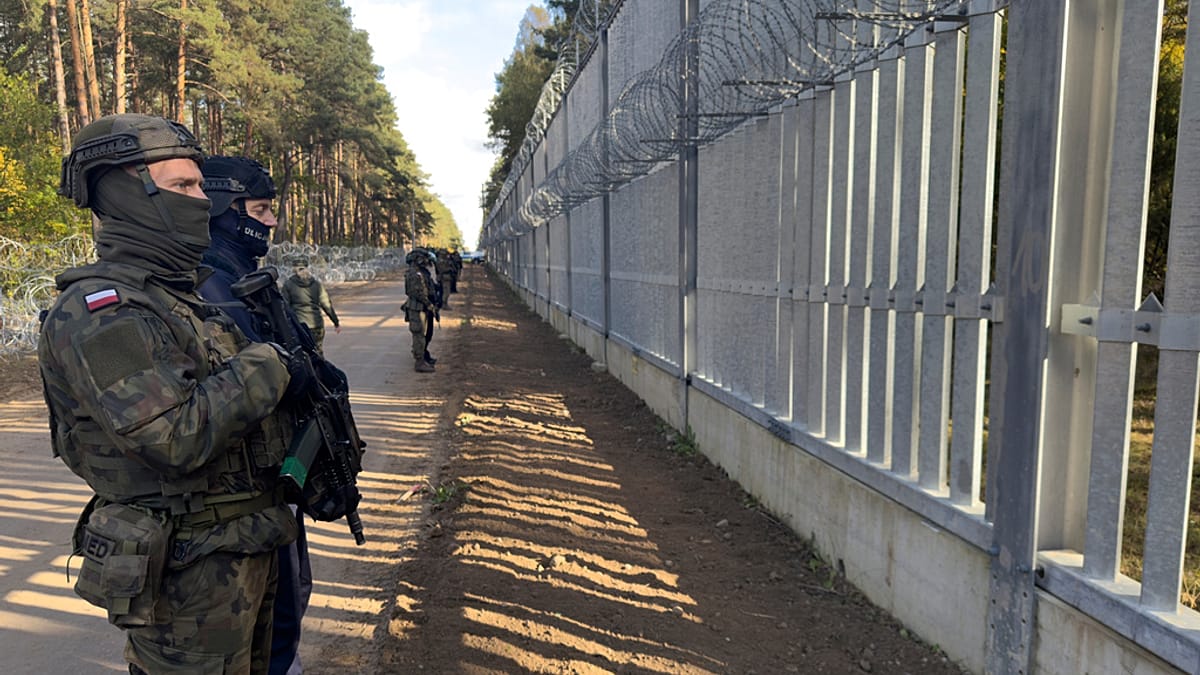
Poland has installed the first cluster of an anti-drone artillery defence system on a new observation tower in Ozierany near the Belarus border, with the cluster due to be operational in January; five such towers have been built at a total cost of roughly 47 million zloty (~€11.1m). The government has deployed more than 4,000 soldiers (over 6,000 personnel overall including Border Guard and police) to border duty amid claims of nearly 30,000 thwarted illegal crossing attempts and reports of migrant deaths; concurrently, opposition group BELPOL alleges Belarus is building a munitions plant (Uchastok) near Minsk to produce 122mm and 152mm artillery/rocket ammunition by December 2026, reportedly reliant on Russian and Chinese inputs and likely supplying Russia. Investors should view this as a regional security escalation that modestly raises sovereign and defense-sector risk exposure, potential for increased defense spending and supply-chain links for munitions components, but it is unlikely to be immediately market-moving outside of defense contractors and regional risk-sensitive assets.
Market structure: Immediate winners are defense primes and munitions/ISR suppliers — think Rheinmetall (RHM.DE), RTX (RTX), LMT (LMT), and Polish state supplier PGZ.WA — because procurement lead-times (6–36 months) and capacity constraints give pricing power to producers of artillery, rockets and surveillance kits. Losers are local border-region services/tourism and any firms with exposure to Belarusian supply chains; sanctioned or Russia-linked suppliers risk losing market access, shifting share to EU/US/third‑country manufacturers. Cross-asset: expect defense equities to re-rate (+15–35% upside possible over 12 months if tenders accelerate), small PLN weakness and modest widening of Polish sovereign spreads (20–80bp), and safe-haven bids in FX/bonds on any escalation.
Risk assessment: Tail risks include kinetic incidents provoking NATO responses or broad sanctions disrupting cross-border inputs (low-probability, high-impact). Timeline: days — volatility and risk‑off flows; weeks–months — formal tender announcements and budget reassignments; quarters–years — munitions plant completion (Dec 2026) altering supply. Hidden dependencies include reliance on Russian/Chinese explosives tech and machine-tool imports; a choke there amplifies price pressure and creates long lead‑time bottlenecks. Key catalysts: BELPOL/further intelligence validation, Polish/EU procurement packages, or Belarus/Russia troop movements.
Trade implications: Direct plays: overweight large defense primes and selective steel/industrial suppliers (ArcelorMittal MT, Nucor NUE) while shorting tourism/leisure names sensitive to border instability (e.g., IAG.L). Options: buy 6–12 month call spreads on RHM.DE and RTX to capture re-rating while capping premium outlay; hedge macro by buying 3–6 month puts on PLN or Polish 10y bond futures if spreads widen >30bp. Entry: scale into positions on 3–7% pullbacks; horizon 6–18 months; take profits at +25–40% or on de‑escalation signs.
Contrarian angles: Markets underprice multi-year munitions supply tightness — even if Belarus ramps production, input dependencies mean Western buyers will still pay premiums for reliable suppliers, favoring listed EU/US primes. The consensus focuses on short-term border tech; miss is prolonged ammo/propellant scarcity that benefits steel/chemicals and machine‑tools makers. Historical parallel: post‑Balkan spikes in 1990s/2000s led to multi-year defense budgets and sustained contractor outperformance. Unintended consequence: accelerated EU joint procurement consolidates winners (large primes) and hurts smaller local contractors unless they scale quickly.
AI-powered research, real-time alerts, and portfolio analytics for institutional investors.
Request DemoOverall Sentiment
moderately negative
Sentiment Score
-0.45
