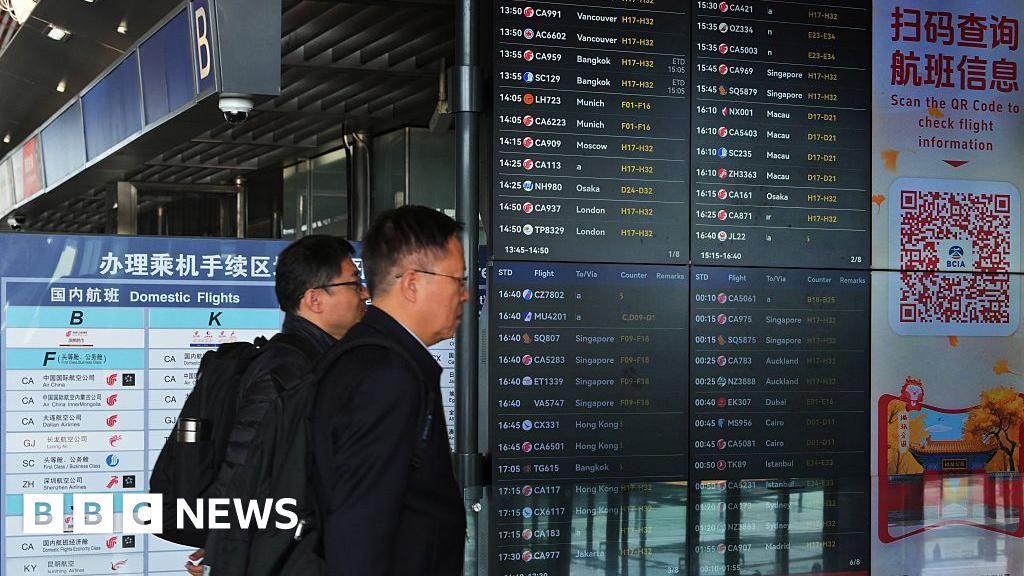
China will allow UK and Canadian passport holders to enter mainland China visa-free for up to 30 days from 17 February through an initial end date of 31 December, covering tourism, business and family visits and aligning rules with about 50 other countries. The move, announced after Prime Minister Keir Starmer's visit, is intended to boost people-to-people exchanges and make it easier for British firms (roughly 620,000 Britons travelled to China in 2024) to expand, and accompanies agreements to deepen ties in services, healthcare, green technology and finance; critics warn of human-rights and security concerns, including debate over a new Chinese embassy in London.
Market structure: Visa-free entry for UK/Canadian nationals materially biases demand toward China-facing travel, favoring Chinese carriers (China Eastern 0670.HK, Air China 0753.HK) and domestic hospitality/OTA players (Trip.com TCOM / 9961.HK, Huazhu 1179.HK). Expect a concentrated 5–15% bump in spring–summer 2026 bookings on UK↔China routes versus baseline, allowing incumbents to raise yields 2–5% on full-service long-haul capacity while low-cost intra-Europe players see little benefit. Cross-asset: modest RMB appreciation (0.5–1%) and 5–10bp tightening in China sovereign spreads are plausible if policy is extended; commodity impact is negligible.
Risk assessment: Key tail risks are diplomatic reversal or a UK security clampdown (10–20% probability over 12 months) and a temporary health shock (<5% probability) that could abruptly curtail flows. Immediate (0–3 months): booking spikes and airline seat-factor improvements; short-term (3–9 months): revenue recognition for carriers/hotels and better earnings revisions; long-term (1–3 years): increased services FDI only if visa policy is extended past Dec 31. Hidden dependency: incremental demand is contingent on carriers adding frequency and visas being extended — monitor government communiqué and route capacity changes.
Trade implications: Tactical longs — establish 2–3% portfolio positions in TCOM (NASDAQ) and 1–2% in IAG (LSE:IAG) to capture UK outbound lift, plus 0.5–1% in 0670.HK or 0753.HK for China seat recovery, with 12–24 month horizon. Pair trade: long TCOM / short Booking Holdings (BKNG) 1:1 to isolate China-specific upside; options: buy Jun–Sep 2026 call spreads on TCOM and IAG sized so max loss = 1% portfolio each to play summer peak. Entry window: scale in March–April 2026; trim/exit if weekly bookings miss trend by >10% or UK Parliament signals reversal.
Contrarian angles: The market may overcount headline demand — visa-free is one-way and temporary (expires Dec 31), so equities could be pricing permanent reopen gains that require policy extension. Also underappreciated is political risk: renewed security concerns could trigger investment screens or route suspensions, quickly reversing multiple expansion. Historical parallel: 2023 reopen rallies saw >30% lifts then snapped back on macro shocks — treat positions as event-driven with hard stop-losses and catalyst-based monitoring (visa extension decision, weekly OTA bookings, capacity increases >10% yr/yr).
AI-powered research, real-time alerts, and portfolio analytics for institutional investors.
Request DemoOverall Sentiment
mildly positive
Sentiment Score
0.22
