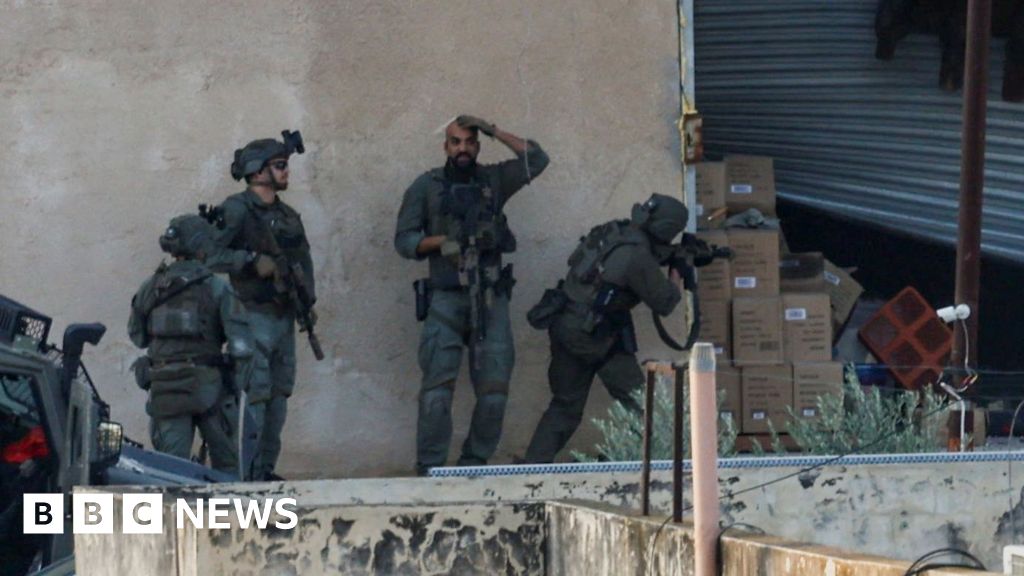
During an Israeli military operation in Jenin, video footage shows Israeli border police shooting and killing two Palestinian men who appeared to surrender; the Palestinian Authority called the killings "war crimes" while Israeli forces say the men were wanted militants and the incident is under review. Far-right national security minister Itamar Ben Gvir publicly backed the officers, and the raid is part of an extended Israeli campaign in the northern West Bank that the UN says has seen more than 1,000 Palestinians killed since October 2023, while Israel reports at least 44 Israelis killed in related violence. The episode heightens legal and political risk around Israeli security operations and could sustain regional risk-off sentiment among investors, though it is unlikely to be an immediate market-moving catalyst on its own.
Market structure: Near-term winners are defense and security suppliers (US large caps LMT/RTX/NOC and regional ESLT) and safe-haven assets (gold, long-duration Treasuries) as risk premia rise; losers are Israel-exposed consumer/tourism, regional banks and the shekel, and local equity funds (EIS) which will see higher volatility and funding gaps. Price-setting power shifts modestly to large defense primes with long backlogs — expect bid/ask expansion and order-book re-rating within 1–6 months, while oil sees only a conditional risk-premium unless escalation reaches Gulf chokepoints.
Risk assessment: Tail risks include regional escalation (Iran/Hezbollah involvement) causing an oil shock >$10/bbl and equities drawdowns >10% in EM MENA; low-probability but high-impact within 1–8 weeks. Immediate (days) will be safe-haven flows; short-term (weeks/months) may produce US defense contract re-pricing and congressional appropriations; long-term (quarters) could lift baseline defense budgets 5–15%. Hidden dependencies: US political support timing, Israeli tech export disruptions, and supply-chain hits to semiconductor/industrial suppliers.
Trade implications: Implement directional and relative-value exposure: favor GLD/TLT and selective defense equities while shorting Israel-country ETFs and travel-reliant names. Use options to cap cost: 3-month call spreads on defense names and bought calls on GLD if implied vol spikes >20%. Entry: act on confirmed risk-off moves (VIX up 10% or 10y UST yield down 10–15 bps) and size trades small (0.5–3% portfolio) with pre-defined stop-losses.
Contrarian angles: Consensus may overpay safe havens and defense primes; historical parallels (2014/2006 Israel conflicts) show mean reversion in 4–8 weeks once localized. Mispricing opportunity: short-term oversell of Israeli tech/financials could present a buy at >15% drawdown; downside is uncontrolled regional escalation — cap exposures and prefer pair trades to hedge geopolitical beta.
AI-powered research, real-time alerts, and portfolio analytics for institutional investors.
Request DemoOverall Sentiment
strongly negative
Sentiment Score
-0.60
