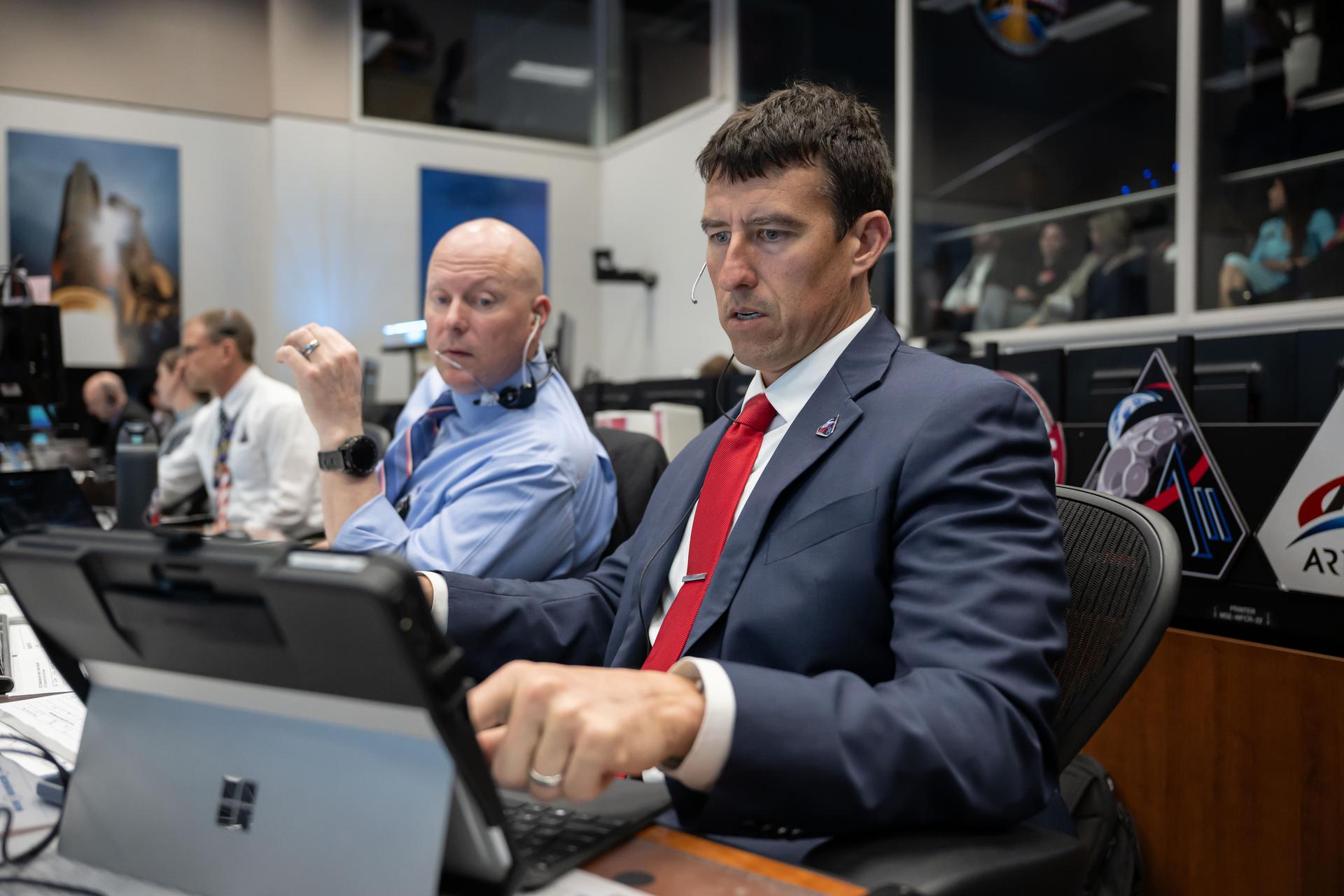
NASA polled 'Go' for Artemis II's translunar injection burn, a 5 minute 49 second main-engine firing beginning at 7:49 p.m. EDT that will provide up to 6,000 pounds of thrust to send Orion toward the Moon. Crew (Reid Wiseman, Victor Glover, Christina Koch, Jeremy Hansen) commenced onboard activities and exercise prep; this is routine mission-progress news with negligible market impact.
A successful translunar injection materially lowers program-level technical risk for the Orion/service-module/SLS stack and shifts the marginal value from ‘demonstration’ to ‘production and sustainment.’ Expect procurement activity to move from engineering change orders to quantity buys and sustainment contracts within 3–12 months; primes that supply propulsion, avionics and composite structures will see more visible revenue cadence and lower discount rates applied to backlog.
Second-order supply-chain effects are where asymmetric returns live: the win creates near-term demand for cryogenic handling, high-reliability RF/comm links, radiation-hardened computing and precision reaction wheels — items sourced from a narrower set of suppliers with pricing power. That tightness can compress lead times and push subcontract margins higher over 6–24 months, benefiting specialty suppliers and systems integrators more than commodity launch services.
Politically and strategically, a clean Artemis II run strengthens the domestic industrial- base narrative, making it easier for Congress and the DoD to justify larger toplines for space-related allocations in the FY+1 and FY+2 budgets. The converse tail risk—a hardware anomaly during insertion or early on-orbit operations—would quickly reintroduce schedule uncertainty and could erase a meaningful portion of the short-term re-rating in small-cap suppliers, producing 20–40% downside in market pricing on sentiment reversal.
The market consensus underweights the portfolio effect: this demonstration doesn't just validate one mission, it lowers programmatic risk across Gateway, lunar logistics and sensor cadence. That suggests concentration in large, diversified primes is a conservative play; higher alpha live in selected suppliers that can prove capacity scale-ups in the next 6–18 months and whose revenues are not already fully priced in.
AI-powered research, real-time alerts, and portfolio analytics for institutional investors.
Request DemoOverall Sentiment
mildly positive
Sentiment Score
0.10
