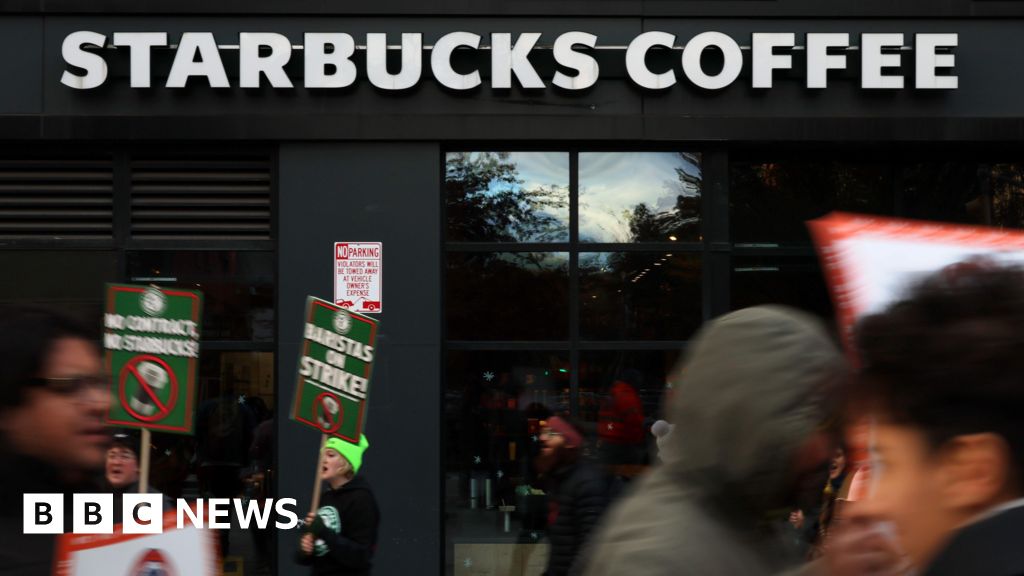
Starbucks agreed to a settlement of more than $35m with New York City over alleged Fair Workweek violations, which will pay over 15,000 hourly workers $50 for each week worked from July 2021 through July 2024; city officials say the company committed more than half a million violations and called it the largest worker protection settlement in NYC history. The deal forces compliance with local scheduling laws as the chain contends with ongoing strikes (expanded to 120+ stores across 85 cities), unresolved unfair labor charges and modest recent sales trends (1% global comp growth, flat U.S. comps), while management pledges a separate $500m staffing and training investment. Implication: the settlement limits near-term legal exposure but underscores operational and labor-risk that could pressure U.S. sales and raise costs, keeping investor focus on staffing, unionization progress and margin impact.
Market structure: The $35m NYC settlement (≈$50/wk per affected worker) is headline-large but economically small — roughly 0.1% of Starbucks' annual revenue — yet it crystallizes recurring labor cost risk. Near-term winners: non-union QSR peers (MCD, YUM) and local coffee independents that can market steadier service; losers: SBUX company-owned US stores where margin per store is most exposed to staffing/scheduling changes. Cross-asset: negligible impact on SBUX IG bonds or coffee commodity prices, but equity volatility and short-dated puts for SBUX should tick up 5–15% on headline risk.
Risk assessment: Tail risks include coordinated national walkouts or binding municipal regulations expanding beyond NYC (10–30% downside scenario over 6–12 months if strikes scale), or conversely successful $500m staffing investment driving a +100–200bps comp lift. Immediate (days) risk is sentiment-driven 3–7% move; short-term (weeks/months) risk is continued strikes and union wins; long-term (quarters/years) is structural margin squeeze if labor mandates spread. Hidden dependencies: franchise mix shift, cost pass-through elasticity (price resistance already visible with US comps flat). Key catalysts: monthly US same-store sales, unionization vote rate (watch >10% company-owned threshold), and Q3 margin guideposts.
Trade implications: Tactical short SBUX or buy protective puts sized 1–2% of portfolio for a 3-month horizon; pair long MCD (or KO) vs short SBUX to capture share-shift and defensive flow over 3–6 months. Options: buy 3-month SBUX put spread (buy ATM, sell 15% OTM) to cap cost if expecting 5–12% downside; if long SBUX, consider covered-call overlays. Rotate 2–4% allocation from discretionary restaurant/retail into QSR and staples until labor/legal picture clarifies.
Contrarian angle: The market may overweight the headline legal risk and underweight the $500m staffing initiative's potential to improve throughput — if implemented well, incremental spend could lift speed/retention and convert into a durable comp recovery. Historical parallels (McDonald’s operational turnarounds) suggest operational fixes can reverse short-term labor-driven sentiment hits. Watch for proving metrics: two consecutive months of US comps +200bps and declining strike counts would be a buy signal; conversely, >10% unionization of company stores or expanding municipal rulings are sell triggers.
AI-powered research, real-time alerts, and portfolio analytics for institutional investors.
Request DemoOverall Sentiment
moderately negative
Sentiment Score
-0.35
Ticker Sentiment
