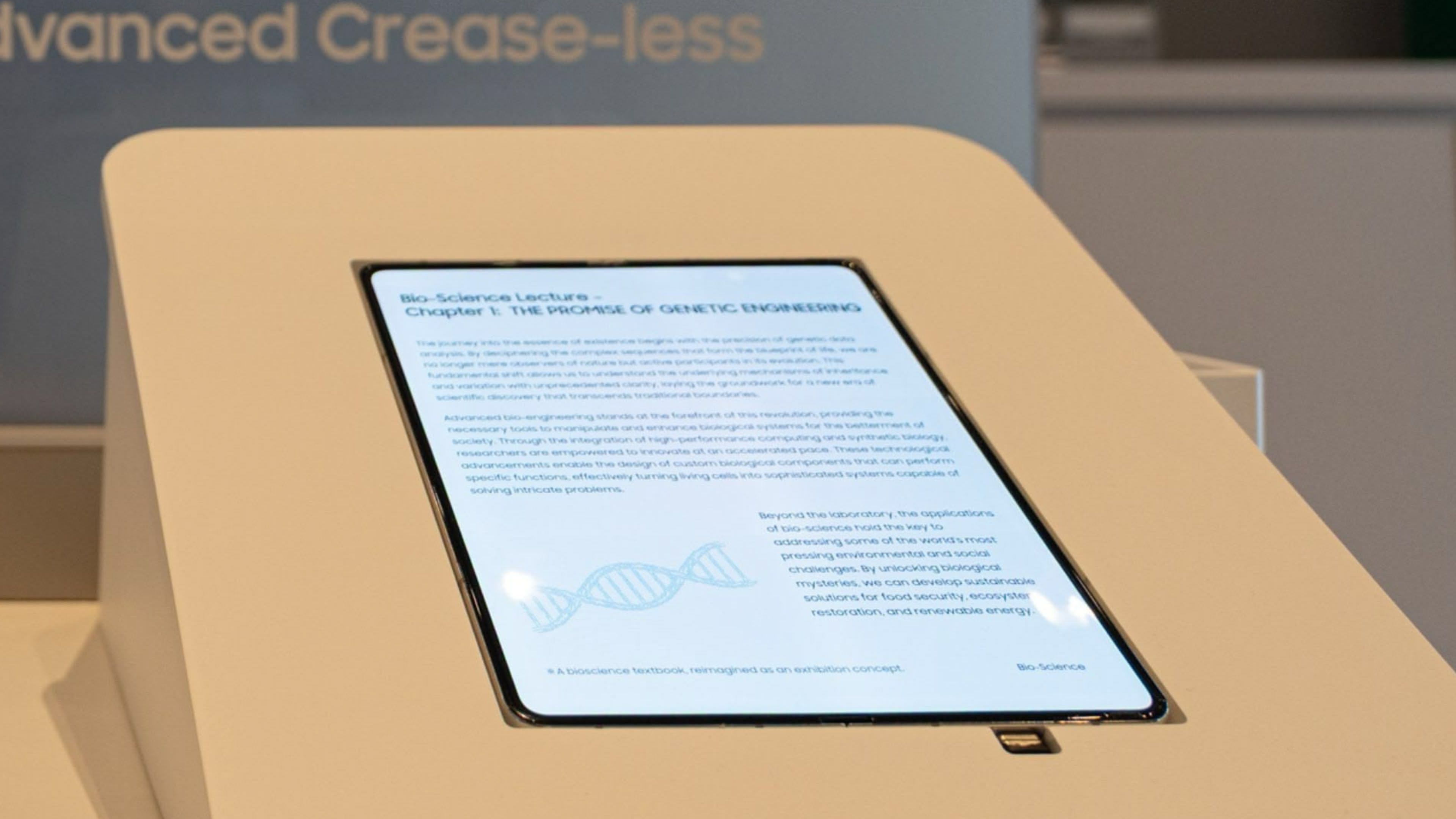
At CES 2026 Samsung Display briefly showcased a new crease‑less foldable OLED panel that it says eliminates visible creasing versus the current Galaxy Z Fold 7, and the company indicated the design will be used in the next Z Fold 8. Analyst Ming‑Chi Kuo and reporting cite a laser‑drilled metal display plate supplied by Fine M‑Tec as the stress‑dispersing component likely to be shared with Apple’s forthcoming foldable iPhone, though Apple reportedly designs its own panel structure and lamination and will use different dimensions (rumored ~5.3–5.5" closed, 7.5–7.8" open). The advance tightens supply‑chain and product requirements for Samsung and Apple suppliers and could influence near‑term supplier allocations ahead of a widely expected Galaxy Z Fold 8 launch this summer and Apple’s mass production and potential mid‑September launch window.
Market structure: Apple (AAPL) is the primary beneficiary — a crease-free foldable that meets Apple design requirements can command a premium ASP and expand addressable wallet share in large-screen phones; if foldables reach 5% of iPhone units in 2026–2027, expect a 25–60bp uplift to corporate gross margin from higher ASP mix. Display suppliers (Samsung Display, Fine M‑Tec) gain pricing power; legacy LCD and lower-end OLED suppliers face price pressure and volume loss. Competitive dynamics: Apple’s bespoke lamination and laser‑drilled plate raise entry barriers; Samsung and other OEMs may be forced into accelerated R&D or accept narrower margins to match Apple’s perceived quality, compressing mid/low-end price competition over the next 12–24 months.
Risks: Tail risks include yield/durability failures, single‑source supplier bottlenecks (Fine M‑Tec), and IP/legal disputes with Samsung that could delay launch by quarters — a >3‑month slip would materially retrade expectations. Near term (days–weeks): headline risk around CES/booth removals; short term (3–6 months): supply confirmations and component price moves (±5–15%); long term (12–36 months): adoption curve uncertainty (scenario range 2–15% market penetration). Key hidden dependency is laser‑drilled plate capacity concentration — one supplier shock could spike component costs 20%+.
Trade implications: Tactical long AAPL exposure into confirmed mass‑production signals (targeting 2–3% portfolio weight) and a hedged options play to capture launch upside; overweight advanced foundries and assembly partners (TSM, Hon Hai) by 1–2% as BOM complexity rises. Pair opportunities: long AAPL vs short mid‑tier Android OEMs that cannot match margin uplift (e.g., Xiaomi) if pre‑order interest is weak. Time trades to catalysts — Samsung Z Fold 8 launch (summer 2026) and Apple production confirmations (by end Q2 2026); expect highest volatility ±8 weeks around launch.
Contrarian: Consensus assumes flawless mass adoption; that’s likely underdone on downside risk — durability or unacceptable ASP (>+$300 vs flagship) could cap volume to a 2–5% niche through 2027, leaving supplier multiples exposed. Conversely, the market may underprice supplier tightness: a Fine M‑Tec capacity shortfall could produce a 10–30% re‑rating for niche display specialists within 3–6 months. Historical parallels (early Apple Watch/AirPods) show Apple can create new categories but only after iterative hardware/fit‑for‑purpose cycles; expect 2–3 hardware generations before foldables become mainstream, so favor staged exposure with explicit stop losses.
AI-powered research, real-time alerts, and portfolio analytics for institutional investors.
Request DemoOverall Sentiment
mildly positive
Sentiment Score
0.25
Ticker Sentiment
